Georgetown Elite Concrete works as a concrete contractor in Bee Cave, laying out and pouring driveways, patios, walks and pool decks and taking on repair, leveling and resurfacing of concrete already in place. Twenty years and more of concrete across this region sits behind that, and the people who walk a site before design are the people who build on it. On most jobs the layout of flatwork is settled by the house, the access and the client’s use of the space. Here there is a fourth constraint that frequently outranks all three, because the city’s tree preservation standards sit in Article 6, Section 6.1 of its Unified Development Code, and a tree in the wrong place will move a driveway before a driveway moves a tree.
The financial shape of that is unusual and worth knowing precisely. A residential tree removal permit is required and carries no charge, while removal carried out without one is charged after the fact at $500.00 per caliper inch removed, with a nonresidential removal permit at $150.00, all under Fee Schedule Section A2.001.
The Tree Decides Where the Concrete Goes
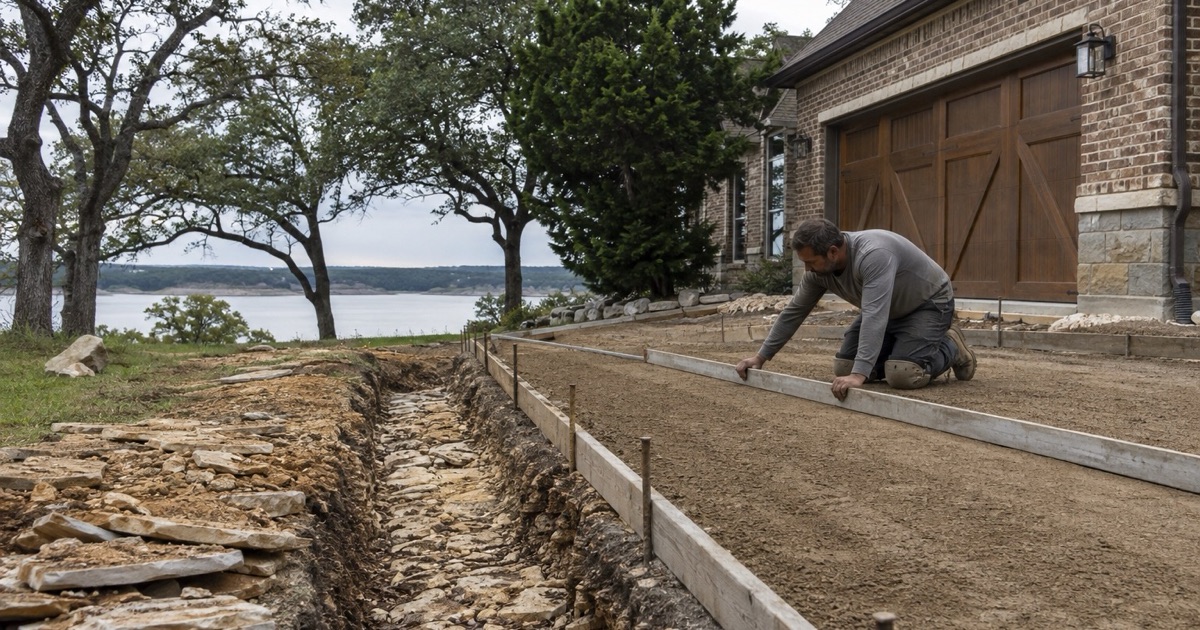
A Free Permit With Real Teeth
A permit that costs nothing is easy to treat as a formality, and that is exactly the trap. The charge for removing a tree without one is $500.00 per caliper inch, which turns a mature tree into a five-figure exposure on a job that may have been worth less than that in concrete. There is no version of this where skipping the permit is economically rational. It costs nothing to obtain and the penalty for not having it is measured per inch, so the only reason it ever gets missed is that somebody assumed a free permit was an optional one.
We treat tree permitting as a gating item on any job that might touch one, in the same category as a utility locate. It is a short conversation before the work rather than an expensive one afterwards. It also protects the owner from a contractor’s decision. A crew that clears an inconvenient tree to make a pour easier has created a liability that attaches to the property, and the homeowner is the one who has to deal with it.
Designing Around Trees Rather Than Through Them
Once removal is genuinely expensive, the design question changes. A driveway that curves around a mature tree, a patio shaped to a canopy, or a walk routed to avoid a root zone all stop being aesthetic preferences and become the cheaper engineering answer.
That is usually a better result anyway. Hardscape laid out around established trees reads as though it belongs to the property, whereas a rectangle imposed on a wooded lot with the trees removed to suit it rarely does.
We start layout from what is already growing rather than from a shape and a square footage. Establishing which trees are staying is the first design decision on a Bee Cave lot, not a constraint applied to a finished drawing.
In practice that means walking the site with the client before drawing anything. Standing where a patio would go, under the canopy that would shade it, produces better decisions than any plan view of the same space.
What Counts and What It Costs
The distinction between residential and nonresidential matters, with the nonresidential permit at $150.00 against no charge for the residential one. On a commercial site with several trees in play that is a modest cost against a scheme that may hinge on them.
What does not change between the two is that permission is required first. The difference is a fee rather than a threshold, and neither category has a route that skips the permit.
We raise it early on commercial work because it affects feasibility rather than just cost. A parking layout that depends on removing several mature trees is a different proposition once the permitting position is understood.
Looking for concrete-contractor closer to Belton? See Concrete-Contractor Services in Belton.
Working Inside a Root Zone
Excavation Where Roots Are
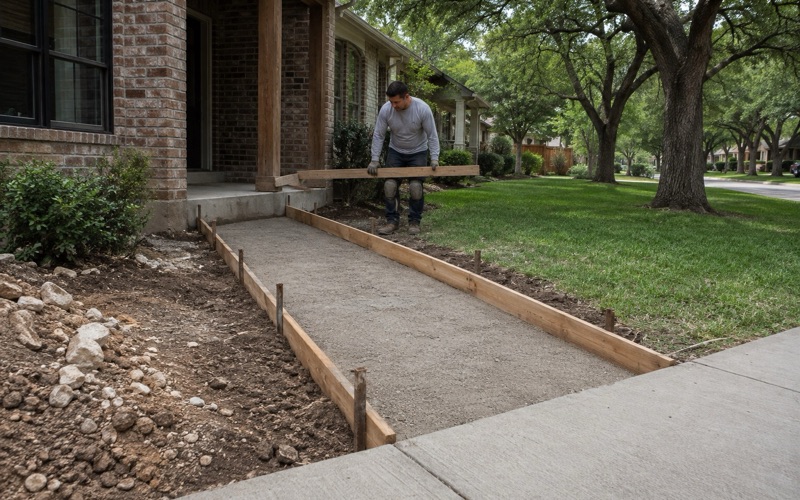
Placing concrete near a retained tree is an excavation problem before it is a concrete problem. Cutting a trench through a root plate can do enough damage to kill a tree over the following seasons, at which point the removal cost arrives anyway along with the loss.
Hand excavation in the sensitive area, working around significant roots rather than through them, and keeping cuts as shallow as the design allows are the standard responses. They are slower and they are far cheaper than the alternative.
We price that time honestly rather than assuming a machine can do everything. A quote that has not accounted for hand work near retained trees is a quote that will either damage them or be revised.
The honest framing is that careful excavation is cheap insurance. Set against a per-inch charge for a tree that dies from root damage two seasons later, a slower morning near a root plate is not a meaningful cost at all.
Edges, Thickness and Slab Design Near Trees
A slab near a tree is a slab that will be asked to accommodate movement, since roots grow and the ground around them changes. Edge detailing, joint placement and thickness all respond to that rather than following a default.
Sometimes the right answer is to stop the concrete short and use a different surface where roots are dense, which keeps the tree and gives a usable route. That is a design decision worth taking deliberately rather than discovering after a slab lifts.
Where concrete does continue past a root zone, thickening the section and placing joints to anticipate movement is better than pretending the roots are not there. Concrete does not win an argument with a growing root; it only decides where it cracks.
Compaction is the other consideration people miss. Running plant repeatedly over a root zone compacts the soil the tree depends on, so access routes across a site matter as much as where the concrete finally goes.
Canopy, Access and Staging
Trees constrain the job physically as well as legally. Canopy decides what can reach a working area, and on a wooded lot the route a truck or a pump can take is frequently the thing that determines how a pour is staged.
We work that out on site rather than on a plan. A layout that is perfect on paper and unreachable by any vehicle capable of delivering concrete is not a layout, and finding that out on the day is an expensive way to learn it.
Patios, Walks and Pool Decks Under a Canopy
Designing for a Shaded Surface
A surface under a canopy behaves differently from one in the open. It stays damp longer, it collects leaf litter and organic staining, and it is more prone to biological growth, all of which bear on the finish and the sealer chosen for it.
We specify with that in mind rather than applying a default. A heavy film-forming sealer on a permanently shaded patio can hold moisture and make the problem worse, which is a straightforward thing to get right and an annoying one to correct.
Texture matters more under a canopy too. A surface that stays damp is a surface that gets slippery, so we specify grip deliberately on shaded walks and pool surrounds rather than choosing a finish for how it looks dry and in sunlight.
Falls and Drainage Around Retained Trees
Drainage design has to account for the trees as well as the building. Directing runoff from a new patio into a root zone changes the water regime a mature tree has adapted to, and doing that at volume is not a neutral act.
So we set falls with a destination in mind that suits both the structure and the planting. On a wooded lot that is usually a more considered exercise than simply pushing water to the nearest low point.
It also has to work in both directions. Water arriving from uphill has to be able to pass a new patio rather than pond against it, and on a lot with mature planting the existing routes are frequently informal and easy to interrupt without noticing.
Pool Decks and Larger Hardscape
A pool deck is the largest single piece of hardscape on many properties here, and it is the one most likely to conflict with retained trees. Getting the position right is a bigger decision than any detail within it.
Other elements carry their own permit triggers worth identifying at the same time, including a retaining wall greater than 4 feet in height and a deck exceeding 200 square feet or standing more than 30 inches above grade. A scheme combining several of those is running more than one permission.
What We Confirm Before Quoting
The Site Walk
Before pricing we establish which trees are staying, which are candidates for removal, where root zones sit relative to the proposed work, and how plant and material can physically reach the working area. Those four answers shape both the design and the price.
Doing that first is what allows a firm quote rather than a range. On a wooded lot the difference between an easy job and a difficult one is substantial, and it is entirely knowable in advance.
Registration and the Permit Route
All contractors and subcontractors must register with the city annually, at $50.00 each under the fee schedule, and permits are applied for and paid through the city’s online portal with Bee Cave selected as the jurisdiction. Registration is a prerequisite rather than a formality.
It is also worth being clear that neither the city nor the state licenses concrete contractors as such. Registration and insurance are the facts that can actually be checked, and a claimed state concrete license describes something that does not exist.
The Other Permissions on Top
A tree permit resolves the tree question and nothing else. Other permissions may still apply to the same project depending on what is being built, and we identify the full set rather than treating one approval as clearing the way.
Bee Cave is a city of 9,144 people in Travis County, and the Planning and Development Department at 4000 Galleria Parkway is open Monday through Friday. A reinspection carries a fee of $150.00, which is another reason we would rather have work genuinely ready when an inspection is called than hope it passes.
- 20+ Years in Georgetown
- Permits Pulled & Inspections Booked
- Free Written Estimates