Georgetown Elite Concrete has worked as a concrete contractor in Brushy Creek for more than twenty years, and the first thing we say to a homeowner here is that the district everyone calls the MUD is not the office that approves your slab. Brushy Creek Municipal Utility District states it plainly: a municipal utility district functions similarly to a city but does not have the broad powers of a city such as zoning and building permitting.
What the District does hold is the ground a crew has to cross. Its easements carry the water, wastewater and storm lines that serve this community, including the raw water line that brings supply in from Lake Georgetown, and in these subdivisions those easements run behind fences and between houses rather than out along a highway.
So the constraint on a back yard patio here is rarely the concrete. It is access, and access comes with a pre-inspection, an application permit fee of $150.00 and a refundable deposit of $250.00 before a machine touches District ground. We price that into the estimate instead of finding it on the first morning.
What the district actually controls
The District’s published jurisdiction is short: stormwater, water and wastewater. Its power to make rules comes from Texas Water Code Chapter 54, Section 205, which lets a municipal utility district adopt and enforce reasonable rules to secure and maintain safe, sanitary and adequate plumbing installations, connections and appurtenances as subsidiary parts of its sanitary sewer system, preserve the sanitary condition of the water it controls, prevent waste and unauthorized use of that water, regulate privileges on any land or easement it owns or controls, and provide and regulate a safe and adequate freshwater distribution system.
Read that list against a driveway or a patio and one clause does the work: privileges on any land or easement the district owns or controls. Nothing in it reaches the thickness of your slab, the mix you order, or where an addition sits on the lot. The District says the same thing from the other direction, in writing: it is the builder’s responsibility to have proper approval from other entities.
The plumbing regime is not a building regime
Where the District does run a permit desk, it runs it over plumbing. A permit is required for the alteration, removal or installation of plumbing, applications come from a registered plumber with current information on file, and the District’s own list of commonly installed items names water heaters, water softeners, pool heaters and irrigation systems. If a patio project takes in a pool heater or shifts an irrigation line, that piece belongs to the plumber and to the District’s plumbing schedule. The concrete itself does not appear anywhere in it.
Where that still touches your schedule
It touches it at the end. Atmos Energy will not set a gas meter until the District issues a release, and that release comes only once District inspections and fees are complete. On a new build with a garage slab and a rear patio in the same contract, we sequence our work so the plumbing side is not waiting on us, because the meter is waiting on the plumbing side. Twenty years of ready mix across Williamson County has taught us that the pour is rarely the thing holding a job up.
Looking for concrete-contractor closer to Jarrell? See Concrete-Contractor Services in Jarrell.
Working inside a BCMUD easement
The District finalized its Easement and Infrastructure Crossing Standards on 10/24/2022. The document sets out the criteria that should be followed by developers, landowners, utilities and any other persons or entities intending to construct surface or subsurface improvements or utilities within BCMUD easements, and the District asks anyone proposing to build within or across one to make contact first, secure any required approvals, and avoid potential delays and conflicts. On a residential job that conversation costs an afternoon. Skipping it can cost a slab.
The reason the standards exist is under the grass. The District’s primary water supply arrives from Lake Georgetown through a raw water line BCMUD owns and operates, generally located within easements, with a second raw water line along Sam Bass Road carrying well water to the plant. That system is retail water service to about 20,000 residents and commercial customers. A surface improvement built over that alignment is an obstacle to whoever has to reach the pipe next, and the standards are written so that the next crew is not cutting your patio apart to get there.
Detailing a slab that can survive a future dig
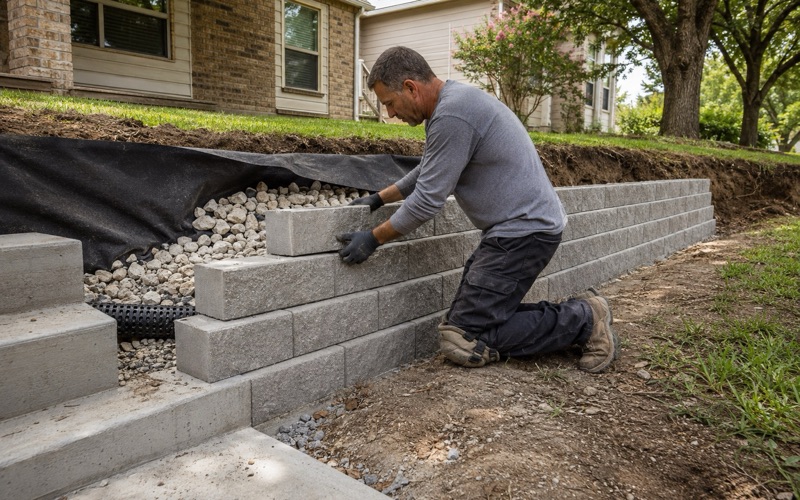
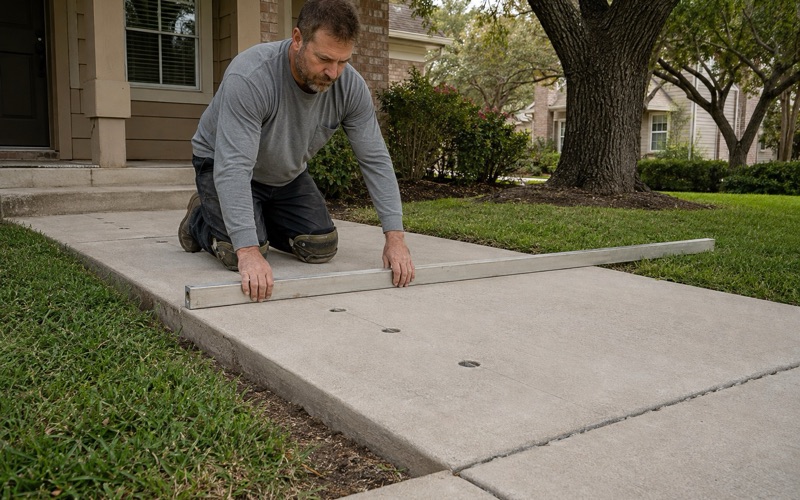
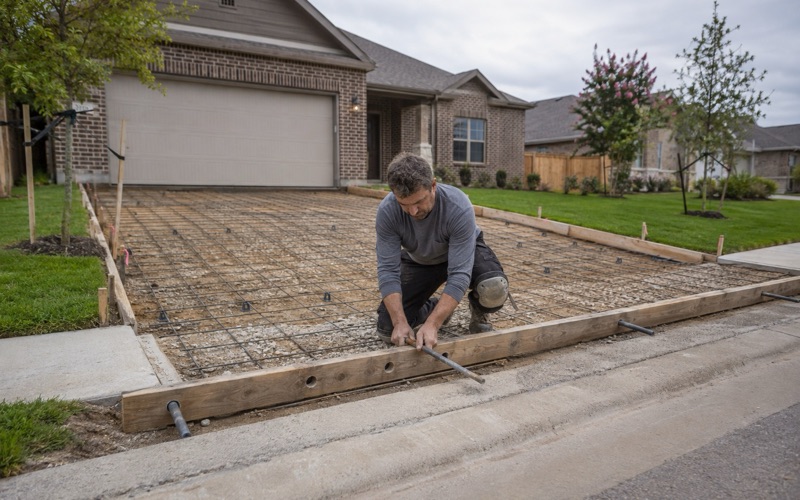
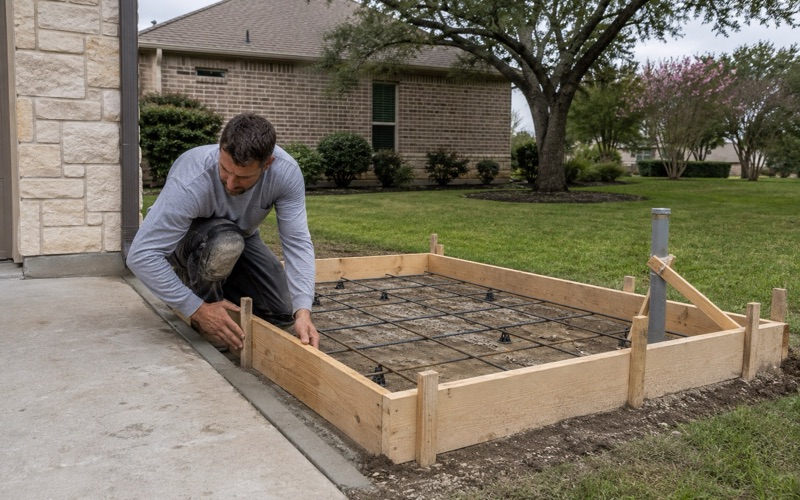
We would rather set a joint than lose a slab. Where flatwork has to finish near an easement, we hold the pour to the easement line wherever the design allows it, and where it cannot be held back we detail the panels so one can be broken out and replaced without taking the rest with it: sawcut control joints on a tighter spacing than habit would suggest, an expansion joint at the boundary, and reinforcement chosen for the panel rather than for the pricing sheet. Number four bar on chairs and welded wire mesh both leave you a panel that can be cut and reset; fiber mesh controls shrinkage cracking but does not.
Rock at eleven inches, or clay at three feet
Excavation here is not uniform, and the difference shows up within a few streets: Eckrant, the dominant soil across roughly 47 percent of the place, carries indurated limestone at 28 to 30 centimeters, about eleven to twelve inches, so a footing trench or a thickened edge reaches rock inside the first foot. The Georgetown series, near 30 percent, is the opposite regime: limestone at 89 centimeters under horizons running to 70 percent clay with a plasticity index as high as 48. Those two ask for different subgrade compaction, a different base course, and a different answer about how deep anything gets opened near a District line. We call Texas 811 on every job and hand dig the last of it once a line is marked.
Access across the trail, and the pre-inspection that comes first
Getting to the work is its own transaction. The Trail and Easement Access Form requires that a pre-inspection be completed by the District’s inspector before a trail or easement is used, and the use of District property is issued to the homeowner rather than to the contractor, so that repairs are secured. The fees are an application permit fee of $150.00 and a refundable deposit of $250.00, and the deposit is returned after a final inspection. A company working in the District for the first time also submits a permit registration form with the application, which is our paperwork to handle rather than yours.
None of that is a building permit, and none of it is a review of the concrete. The inspector is looking at District property before and after: the surface, the turf, the trail and whatever runs below them. That is a narrow question with a clear answer, which is exactly why it goes badly when nobody asked it until the morning of the pour.
No equipment and no spoil overnight
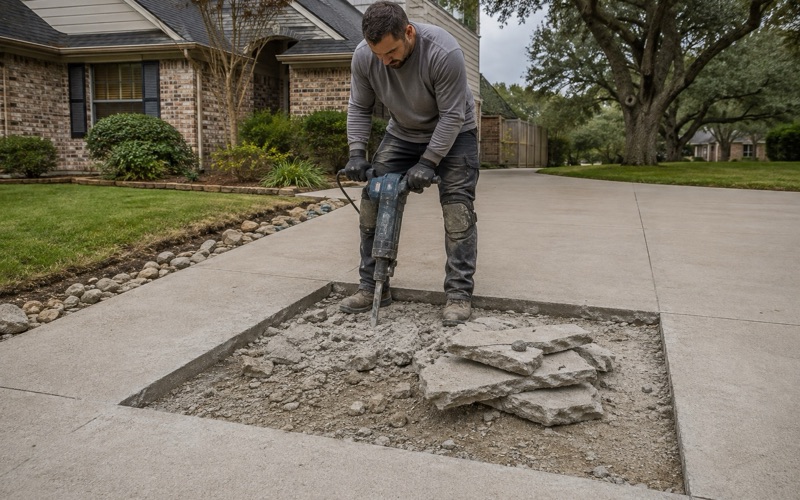
The form is unambiguous on one point: absolutely no equipment or spoil piles shall be left over night on District property. That single sentence decides how a job here is sequenced. Excavation and haul-off happen inside one day instead of drifting across three, spoil goes straight into a truck rather than onto the greenbelt, and the machine is back on the driveway before dark. We would rather bid the extra trucking than leave a customer’s deposit exposed.
Placing concrete when the truck cannot get close
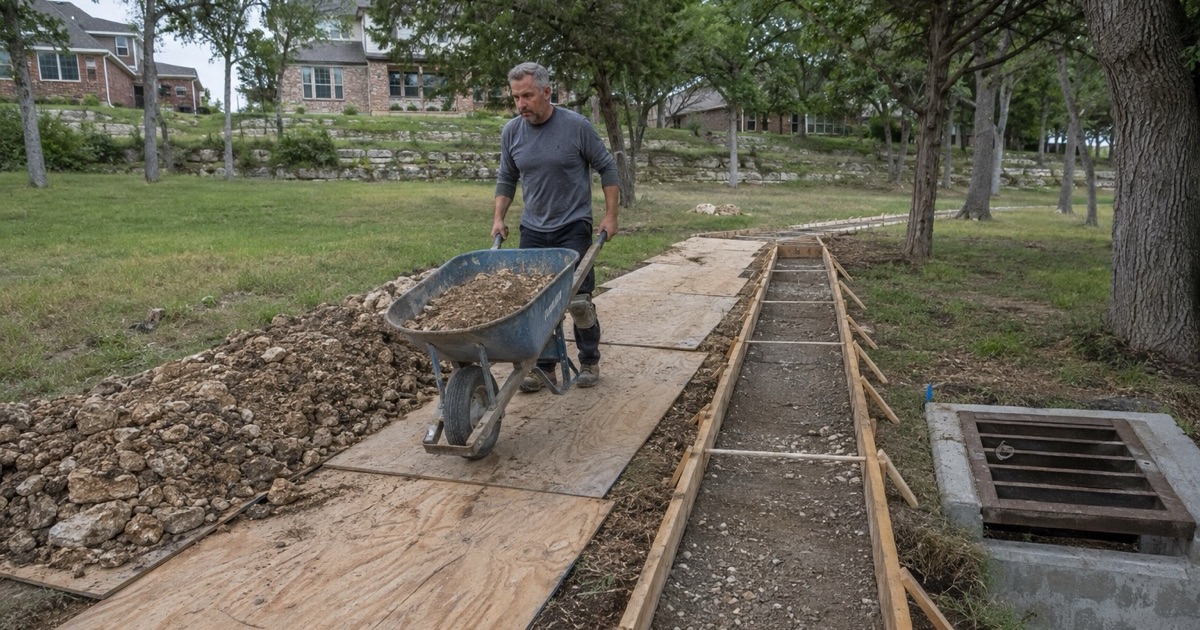
Back yards reached across an easement rarely see a chute. We plan for a pump or for buggies, confirm the route in the pre-inspection rather than assuming it, and protect the surface we cross, which is often paved already: the Brushy Creek Regional Trail is an approximately 7.75-mile, mostly concrete path, and a tracked machine crossing concrete of unknown age and thickness is a repair bill waiting to be assigned. Mats and a planned route are cheaper than a panel replacement, and a lot cheaper than an argument about who cracked it.
Who signs off when the district does not
Williamson County does, and the instrument is a floodplain instrument rather than a building permit. Per county ordinance, a Certificate of Compliance is required for all structures or other developments outside of a floodplain in the unincorporated areas of the county, verifying that no 100-year floodplain exists in the area of the proposed development, and where a property is within or adjacent to a 100-year floodplain a Floodplain Development Permit must be issued before construction. Both are filed through MyGovernmentOnline, and the county’s own answer to the question of whether you need a building permit names no county building permit at all. If the lot sits in a recorded subdivision, the plat notes are worth reading first: where a Defacto Certificate of Compliance was issued with the recorded plat, an application may not be required.
Most of the community also falls inside an extraterritorial jurisdiction, and that is a platting power, not a building-permit power. Local Government Code Section 212.003 provides that a municipality shall not regulate, in its extraterritorial jurisdiction, the use of any building or property for business, industrial, residential or other purposes, the bulk, height or number of buildings on a tract, the size of a building that can be constructed on a tract, or the number of residential units per acre.
The reviewer most likely to look at your finish
With no city hall, the association is the most active design reviewer here, and it is not uniform. The District’s own table divides its neighborhoods into those with an active association, among them Cat Hollow, Highland Horizon, Hunterbrook, Meadows of Brushy Creek, Sendero Springs and Woods of Brushy Creek, and those with none: Brushy Creek North, Brushy Creek South and Highlands of Brushy Creek, Liberty Village and Neenah Oaks. Whether a broom finish, an exposed aggregate band or a color choice needs anyone’s approval depends on which side of that table your street sits on.
What we put in writing before the truck is ordered
We name the document your job answers to, whether that is the crossing standards, the county’s certificate, an association’s guidelines, or, on a commercial building, the plan review for fire protection the Sam Bass Fire Department will want. And when we quote a small job, we tell you the size of job the square-foot number was worked out from, because a price per square foot with nothing behind it is not a price. The rest is the ordinary discipline: 4000 PSI where the loading earns it, air entrainment and slump agreed with the plant rather than adjusted at the curb, compaction that was actually checked, a vapor barrier where one belongs, and curing compound down before the crew leaves.
- 20+ Years in Georgetown
- Permits Pulled & Inspections Booked
- Free Written Estimates