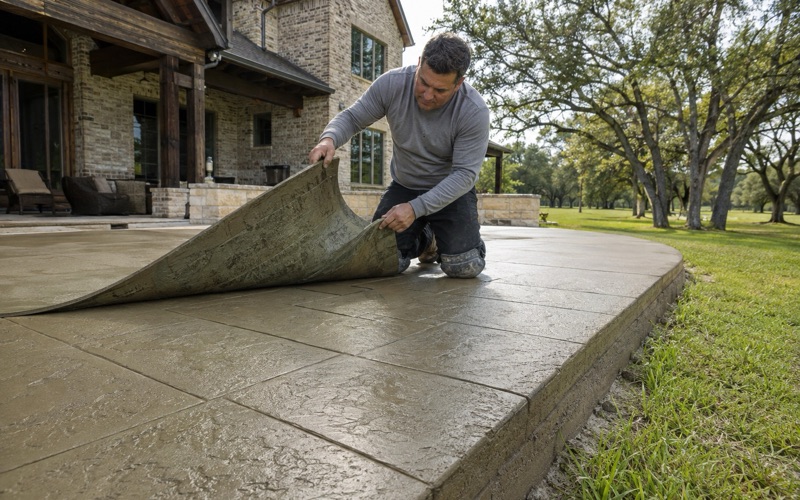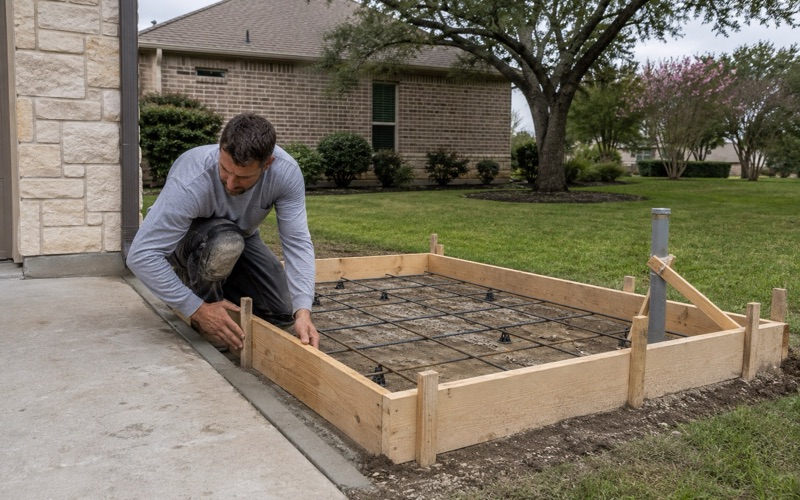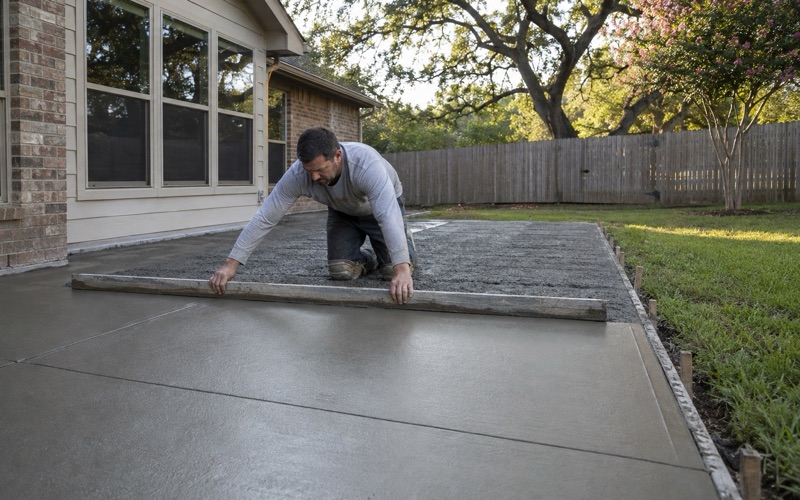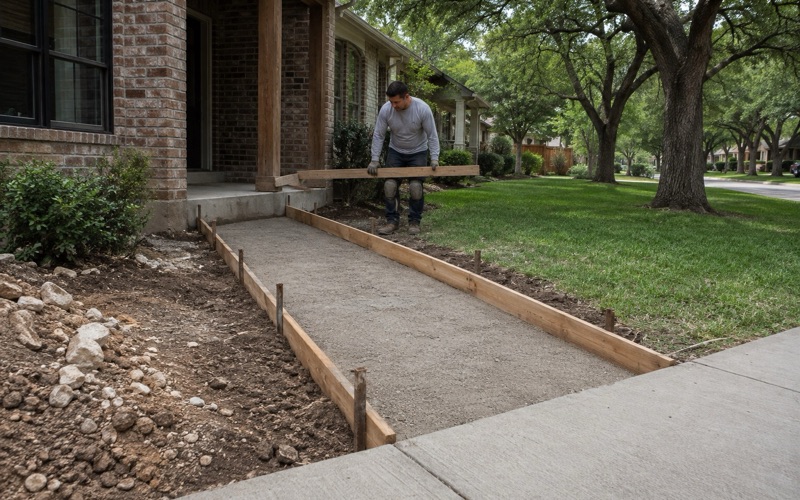
Georgetown Elite Concrete works as a concrete contractor in Cedar Park, pouring driveways, slabs, patios, walks and commercial flatwork, and repairing, leveling and resurfacing concrete that is already down. Twenty years and more of concrete across Williamson County sits behind that, and the crew that reads the ground on your lot is the crew that places the concrete on it.
The thing that makes concrete work here different from the same job a few miles away is not the mix and not the finish. It is that most of this city sits over a protected aquifer, which brings a state agency into a job that would otherwise involve only a contractor and an owner. Sampling the city polygon on a regular grid of interior points against the official Edwards Aquifer layer returns 81.9 percent contributing zone and 6.0 percent recharge zone, with 12.1 percent outside any mapped Edwards zone.
That single fact reorganizes the schedule. It decides whether plans go to a state regulator before anything is dug, what has to be physically present on the site while work proceeds, and what a crew is obliged to do the moment an excavation opens something unexpected. We establish which zone a property falls in before quoting, because the answer changes the program rather than the price alone.
Which Edwards Zone a Cedar Park Lot Falls In
The Contributing Zone Across Most of the City
Roughly four fifths of sampled points inside the city return Edwards Aquifer contributing zone, and server-side queries at separate locations across the city both come back the same way. Contributing zone means water shed here drains toward the recharge area rather than entering the aquifer directly beneath your slab, and the regulatory program reaches it accordingly.
What that means in practice is that a project’s water quality plan is reviewed by the state rather than settled locally, and that the review sits ahead of the work rather than alongside it. We treat it as a program item with a lead time attached, not as paperwork to be caught up with once the forms are set. An owner who hears about the review for the first time when the concrete is ordered has already lost the weeks it takes.
The Recharge Zone Minority, and What Changes There
A smaller share of the city, around 6 percent of sampled points, falls in the recharge zone proper. It is genuinely a minority of Cedar Park and it is not correct to describe the city as sitting in the recharge zone; what is correct is that some properties do, and the ones that do carry the tighter end of the program’s requirements.
Because the two zones are interleaved rather than neatly divided, an address is the only reliable way to answer the question. Neighboring lots can fall differently, so we check the specific parcel against the official layer rather than reasoning from what the last job down the road required. A quote built on the neighbor’s experience is a quote built on the neighbor’s parcel, which is not the one being poured.
The Twelve Percent That Is Outside Any Mapped Zone
Around one point in eight inside the city returns no mapped Edwards zone at all. On those properties the aquifer program is simply not the constraint it is elsewhere, and a straightforward driveway or patio proceeds without a state review sitting in front of it.
That is worth checking rather than assuming in either direction. Assuming the program applies adds weeks to a job that did not need them, and assuming it does not is the more expensive mistake, so the zone check is the first thing we do on a Cedar Park enquiry. It costs nothing and it decides whether the job is a three-week program or a three-month one.
Looking for concrete-contractor closer to Wells Branch? See Concrete-Contractor in Wells Branch.
Notice, Paperwork and What Stays On Site
Written Notice to the TCEQ Regional Office
Where work proceeds under an approved Edwards Aquifer plan, the contractor owes the Texas Commission on Environmental Quality regional office written notice no later than 48 hours before construction begins. It is a fixed obligation on the contractor rather than on the owner, and it is the one most often missed by a crew that arrived to start.
The Austin Region office administers the program under 30 Texas Administrative Code Chapter 213 and can be reached on 512-339-2929. We put that notice in ourselves, on our own schedule, so an owner is not left chasing a deadline that belongs to whoever is holding the shovel. It also means the notice goes in against a start date we control, rather than one guessed at a fortnight out.
Plans and Approval Letters Kept Where They Can Be Read
The approved plans and the approval letters have to be kept on site and accessible to agency personnel for the duration of the work. That is a physical requirement rather than an administrative one: the documents live in the site box, not in an office or an inbox somewhere.
It matters because an inspection is unannounced by nature. A site that cannot produce its approval on the day is a site that has failed a check it would otherwise have passed comfortably, which is an avoidable way to lose a week on a driveway. Keeping the file in the site box costs nothing and removes the whole category of problem.
Protective Barriers Before the Grader Moves
Where sensitive features such as caves, sinkholes and wells are present, protective barriers go in around them before grading starts rather than once earthworks are underway. The sequencing is the whole point of the requirement, since a feature disturbed by the first pass cannot be protected retrospectively.
On a site with any such feature we walk it and set the barriers as a distinct task with its own sign-off, ahead of machinery arriving. That also protects the client, because a damaged feature becomes a much larger conversation than a delayed one. Barriers set early also survive the job, whereas ones improvised around working machinery rarely last the week.
When an Excavation Opens a Void
The Six Inch Rule
A contractor working under an approved plan must give written notification to the agency if a void larger than 6 inches in any direction is encountered. It is a specific, measurable trigger rather than a judgment call, which is useful, because it removes the temptation to decide on the spot that something is probably nothing.
We brief crews on that threshold before they break ground on an aquifer job, and we stop and measure rather than backfilling and carrying on. A void reported properly is a short pause; a void quietly filled is a problem that surfaces later with somebody’s name attached to it. The measurement is quick, the notification is routine, and neither is worth avoiding.
Why Voids Turn Up Here at All
Ground across most of this city is shallow soil over indurated limestone rather than deep clay, with Eckrant the dominant soil component at 45.5 percent of the clipped area and rock reaching within roughly the first foot across the two largest map units. Limestone that close to the surface is exactly the material in which solution features form.
So the void requirement is not a formality imported from elsewhere; it reflects what the ground here genuinely does. Excavating for a footing or a thickened edge is the operation most likely to open one, which is why the trigger sits on the contractor rather than on the designer. Nobody can predict a solution feature from a drawing, and only the person in the trench can see one.
Spills, Fuels and the Other Reportable Event
The same program treats a fuel release as a reportable event, with a spill of 25 gallons or more of gasoline or diesel carrying its own notification obligation. Plant and delivery vehicles are the realistic source on a flatwork job, which makes it a fueling and maintenance discipline rather than an abstract one.
We keep fueling off the sensitive parts of a site and carry spill materials as standard on aquifer work. That is cheap insurance against an incident that would otherwise dwarf the value of the concrete being placed. A pour is a few hours of plant on site, and that is long enough for a spill to happen.
Exemptions, Reviews and Who Decides
The Twenty Percent Impervious Cover Test
A private residence can fall outside the requirement for an individual Edwards Aquifer plan on a percentage test rather than a square footage one: no more than 20 percent impervious cover within the property’s legal boundaries, with rooftops, driveways, concrete pads, sheds and sidewalks all counted in.
That has a direct consequence for anyone adding flatwork. A new drive plus a patio plus a shed pad can move a lot across the line, so the calculation belongs at the design stage. A rainwater harvesting system can be used to bring adjusted impervious cover back to the threshold where a project would otherwise exceed it. Running that arithmetic while a patio is still a sketch is a great deal cheaper than discovering it once a plan has been submitted.
The Other Routes to the Same Exemption
There are two further routes. A residence forming part of a master community that already holds an approved plan is covered by that plan, and a single residence on a lot larger than five acres is treated separately again.
Which route applies changes what has to be produced and when, so it is worth settling before design rather than during review. We ask about the community’s existing approvals early, because inheriting one is considerably faster than obtaining one. Many of the larger neighborhoods here already sit under an approved plan, and the homeowner is frequently unaware of it.
Who Reviews What
The review authority is not the city. Code section 12.16.002 requires plans to be reviewed by the state agency where a site lies in the contributing or recharge zone, or by the City on behalf of the Lower Colorado River Authority where it lies in the Lake Travis Watershed, and states that state approval is required before a site development permit issues.
That order matters because it is a sequence rather than a set of parallel conversations. The stormwater article also sets its own practical threshold, exempting additions or modifications to existing single-family structures and projects creating no more than one thousand square feet of additional impervious cover where they are not part of a larger common development plan.
- 20+ Years in Georgetown
- Permits Pulled & Inspections Booked
- Free Written Estimates