Georgetown Elite Concrete delivers commercial concrete in Georgetown, TX, with more than twenty years of concrete across Williamson County and projects in surrounding cities including Serenada, Santa Rita Ranch, Round Rock, Brushy Creek and Jarrell. Commercial work differs from residential less in the concrete than in everything around it: the approvals, the phasing, the traffic that cannot stop, and the standards a site has to satisfy before it opens.
The approval instrument is the first thing to get right, and more than one can apply. A Site Development Plan is required before constructing, expanding or removing driveways, sidewalks, drainage structures and utility improvements inside the city limits, with single-family and two-family structures on individually platted lots exempt. A city driveway permit covers work altering an approach, and inside an overlay a Certificate of Appropriateness can be triggered as well.
Getting that wrong costs weeks rather than money, which is why we identify the instrument at the quoting stage rather than at submission. We also plan around the constraint most commercial programs discover late: right of way work on Georgetown arterials runs half past eight to half past three with no weekends, which is a seven hour working window.
Commercial Flatwork and Paving
Parking Lots From Subgrade to Striping
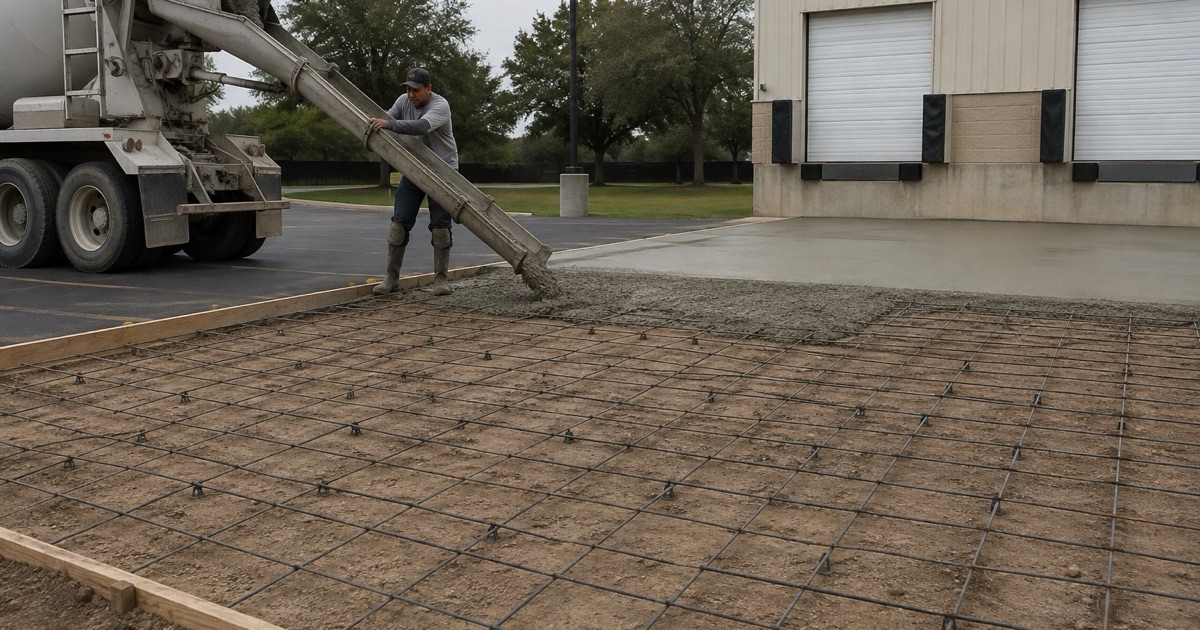
A parking lot is a structural problem wearing a paving problem’s clothes. Subgrade compaction, base course, thickness and jointing all follow the heaviest vehicle that will ever cross the lot, which is usually a loaded refuse truck rather than a car. We build to ACI 330 practice for concrete parking lots, and we dowel the joints that carry traffic across them so panels do not step apart under load.
Drive Aisles, Loading Areas and Heavy Traffic Zones
Traffic on a commercial site is not evenly spread, so neither should the slab be. Drive aisles, loading docks, refuse routes and turning areas take load concentrations that the parking bays never see, and building the whole lot to the worst case is wasteful while building it to the average is a failure. We thicken and reinforce the zones that need it and say where the boundaries are.
Dumpster Pads and Their Screening
Georgetown files dumpster pad requirements in its landscaping and screening article at UDC 8.04.070 rather than in solid waste, which is precisely why they are missed until a plan review comment arrives. A pad takes a loaded truck’s wheel loads plus the impact of a container being dropped back down, so it is a heavier section than the field around it. We build the pad and coordinate the screening to clear review together.
Bollards, Curbs and Protective Concrete
Concrete filled bollards, curbs and wheel stops exist to take impacts that would otherwise reach a building, a storefront or a gas meter, which makes them consumable elements that fail predictably at the base. Setting the embedment properly is the whole job. A bollard that looks solid and is no longer anchored gives false confidence, which is worse than one that is visibly damaged.
Code, Accessibility and Approvals
Accessible Routes and Curb Ramps
Accessibility on a commercial site is measured rather than judged: running slope, cross slope, landing dimensions, changes in level and detectable warning surfaces all carry numbers in the Texas Accessibility Standards. A route that misses one fails inspection no matter how it looks. We set out and screed to those tolerances and check them while the concrete is still workable, because correction afterwards means demolition.
Public Sidewalks and Frontage Obligations
Sidewalks and sidepaths must be constructed on both sides of all streets, including frontage roads, in new development, and pedestrian accessways have to run from the public sidewalk to a building’s main entrance. In the Downtown Overlay District the developer carries responsibility for the sidewalks, landscaping and lighting the Downtown Master Plan calls for where those do not exist or need reconstruction.
The Engineer’s Certification and Closing Out
Georgetown requires an engineer’s certification once foundation construction or the concrete application is finished, and the code specifies that it shall contain no opinions or disclaimers. On a commercial program that certification sits on the critical path to occupancy, so a hedged letter is not merely unhelpful, it stops the job. We build to a standard an engineer will certify cleanly and we flag the requirement at tender.
Impervious Cover and Site Constraints
Impervious cover governs how much of a site can be built on, and the limits vary by district and by whether the site sits inside the city or the extraterritorial jurisdiction, where single-family and two-family development with public wastewater service is capped at 45 percent and development without it at 40 percent. Separate limits apply over the Edwards Aquifer Recharge and Contributing Zones, which reach the west of the city.
Delivering Work on a Live Site
Phasing Around a Business That Stays Open
A trading business cannot surrender its car park or its entrance for a fortnight, so commercial concrete is sequenced work rather than a single visit. We break a lot into phases, keep an accessible entrance and a service route available throughout, and time pours so each area returns before the next is taken. That costs more in mobilization and far less in lost trading.
Working Inside the Right of Way Window
Where work reaches the public right of way on an arterial, the seven hour window between half past eight and half past three, with no weekends, determines what can realistically be achieved in a day. Pours, deliveries and traffic control all have to fit inside it. We program the street-facing element around that constraint from the beginning rather than absorbing the loss later.
Utilities, Locates and What Is Under the Lot
Commercial sites carry more buried services than residential ones and older lots frequently carry undocumented ones. Every excavation goes in behind a Texas 811 locate, and we probe where records look unreliable rather than trusting a drawing. The cost of a careful morning is trivial against the cost of a struck service and the delay that follows it.
Curing, Opening and Handing the Site Back
The date a surface reopens is set by curing rather than by placing, and on a commercial site that date has real financial consequences. We give separate dates for foot traffic and for vehicle loading, and we plan the phase boundaries around them so no area is closed longer than the concrete actually requires. Opening a lot early is how a new surface earns its first failure.
- 20+ Years in Georgetown
- Permits Pulled & Inspections Booked
- Free Written Estimates