Georgetown Elite Concrete handles concrete repair in Georgetown, TX and has spent more than twenty years fixing concrete across Williamson County, serving surrounding cities including Serenada, Santa Rita Ranch, Round Rock, Brushy Creek and Jarrell. Repair is diagnostic work before it is concrete work, because the same crack can be a curing artifact worth sealing or the visible end of a problem underneath the slab.
The local diagnosis is genuinely different here, and the difference is that Georgetown sits on shallow soil over limestone rather than on deep prairie clay. Linear extensibility is where the two separate: Eckrant measures 2.7 to 6.1 percent and Castephen 3.8 to 4.5 percent, against Branyon at 9.9 to 13 percent and Houston Black at 12 percent through the profile. Less seasonal heave, in other words, but shallow rock hands you rigid bearing and hard excavation instead.
That matters when someone tells you your cracked drive is expansive clay doing what expansive clay does. Sometimes it is, because these shallow soils still test expansive, with Eckrant carrying a representative plasticity index of 32 and a liquid limit of 60 at 42 to 45 percent clay. Often it is a washed-out trench, a slab bearing on rock at one end and fill at the other, or an edge nobody protected. We work out which before quoting anything.
Reading Cracks Before Repairing Them
Shrinkage Cracks and Curing Artifacts
A crack that wanders, stays hairline along its whole length, and shows no offset between its two sides is almost always shrinkage from the first days of the pour. It is a surface defect rather than a structural one. These get cleaned and filled to keep water and debris out, and we say plainly that the work is cosmetic rather than dressing it up as a structural repair.
Cracks That Are Telling You Something
A crack running straight rather than wandering, opening wider at one end, showing a vertical lip between the two sides, or reappearing in the same line after being filled is reporting movement underneath. So is a crack that continues through a control joint instead of stopping at it. We investigate the support before touching the crack, because a filled crack over a moving slab simply opens again a few inches away.
Spalling, Scaling and Surface Loss
Spalling is concrete breaking away from the surface, usually where reinforcement is corroding, where the surface was overworked while bleed water was still present, or where a de-icing or fertilizer salt has attacked the paste. Scaling is the same story at a shallower depth. We identify the mechanism first, because patching over corroding steel buys a season and then costs more than doing it properly.
Joints That Have Failed Rather Than Concrete
Owners routinely call about a failed joint and describe it as a crack. Expansion joints lose their filler, control joints ravel at the edges, and a bituminous joint filler that has hardened and dropped stops absorbing movement, at which point the adjacent concrete starts taking the load. Re-cutting and refilling joints is often the whole repair, and it is a fraction of the cost of slab work.
Structural Repairs and What Sits Underneath
Slabs That Have Lost Their Support
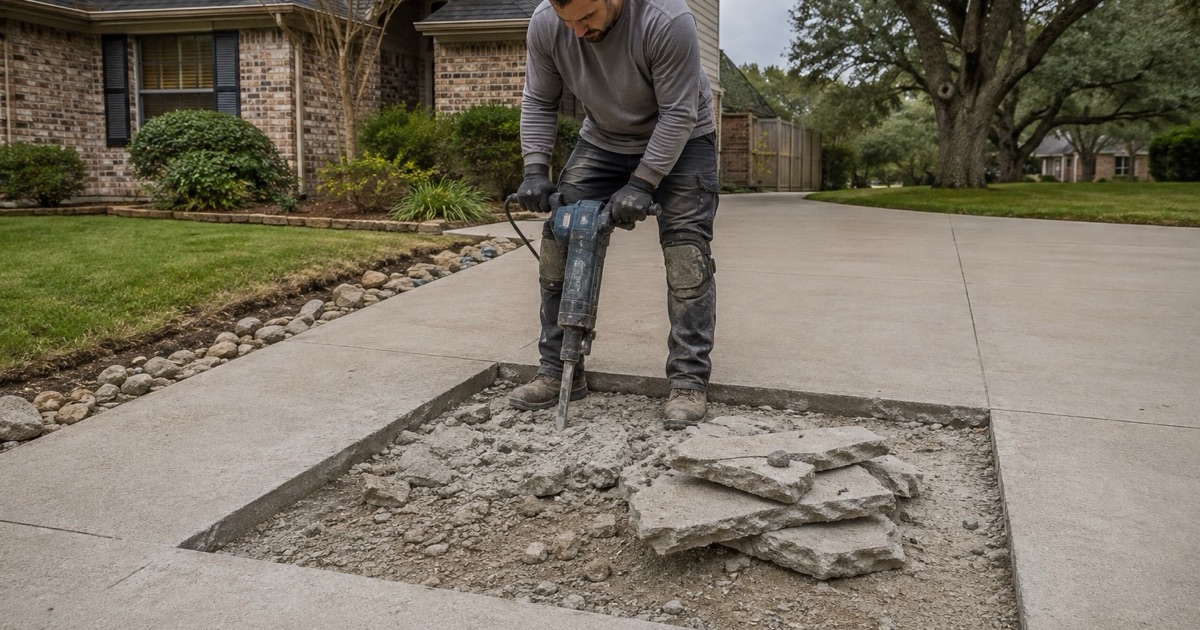
When a slab has lost bearing over part of its area it flexes under load and cracks in a pattern that maps the void rather than the joint layout. The usual causes here are poorly compacted backfill over a utility trench, water tracking along a footing, and erosion at an unprotected edge. We locate the void and decide whether the slab is worth lifting, worth patching or beyond either.
Repairs Across a Bearing Transition
A slab that begins on Eckrant with indurated limestone at a representative 11 to 12 inches and ends on deeper soil is supported two different ways along its own length, and it will crack at the transition no matter how good the concrete is. The repair has to accommodate that rather than pretend it away, usually by making the transition a deliberate jointed break instead of leaving it as an accidental one.
Steps, Landings and Thresholds
Steps are where concrete damage becomes a trip hazard rather than an appearance problem. A settled landing changes one riser height and that is the one people catch a toe on. Sun City’s guidelines treat elevation as a safety matter directly, requiring safety handrails 3 to 4 feet in height where a porch, patio, deck or raised floor surface stands more than 30 inches above finished grade. We rebuild the geometry rather than patching the tread.
Edge and Corner Reconstruction
Slab edges fail first because they are unsupported on one side, carry wheel loads at their weakest point and take the water running off the surface. Rebuilding an edge properly means cutting back to sound concrete, dowelling into it and matching the mix and finish, rather than feathering a thin skim over a broken lip that will spall off again within a year.
Materials, Mixes and Doing It So It Holds
Bonding New Concrete to Old
Cured concrete does not naturally bond to fresh concrete, so a repair holds because of preparation rather than because of the mix. That means mechanical profile on the substrate, sound concrete to bond to, no old sealer or release agent left in the surface, and a bonding agent or a mix designed for the job. We test the surface rather than assume it, and we say when there is not enough sound concrete left to bond to.
Matching Color, Texture and Finish
A structurally perfect patch that reads as a patch from the street has only half solved the problem. Concrete color shifts with mix, age, curing and the finishing pass, so an exact match to weathered concrete is rarely achievable and anyone promising one is guessing. We aim the repair at a deliberate break line, match the broom finish direction, and tell you honestly what the finished result will look like.
The Mix Specified for the Repair
Repair mixes get chosen for what the repair has to do rather than pulled off the same ticket as everything else. Compressive strength, aggregate gradation, slump and water cement ratio all move depending on whether we are dowelling a driveway edge, filling a void or casting a new landing. We put the specification on the proposal so it can be checked against the ticket on the day.
The Engineer’s Certification, and Where Repair Crosses Into It
Some repair work stops being maintenance and becomes construction, and Georgetown draws a firm line at that point: an engineer’s certification is required once foundation construction or the concrete application is finished, and the code states it shall contain no opinions or disclaimers. That wording rules out the qualified letter people often expect. We tell you at survey which side of that line your job sits on.
Concrete Repair on an Occupied Commercial Site
Trip Hazards and the Accessible Route
On a commercial property a lifted joint or a settled panel stops being an appearance problem and becomes a liability one, particularly where it sits on an accessible route. Running slope, cross slope and changes in level all carry numbers in the Texas Accessibility Standards, so a repair that leaves the surface out of tolerance has not fixed anything. We measure the route rather than eyeballing it and rebuild the panel to a compliant profile.
Working Without Closing the Site
A business cannot give up its entrance for a fortnight, so commercial repair is sequenced work rather than one visit. We break the job into panels, keep an accessible way in throughout, and schedule pours so the areas taken out of service come back before the next ones go down. That usually costs a little more in mobilization and considerably less in lost trading.
Bollards, Wheel Stops and Impact Damage
Concrete filled bollards, curbs and wheel stops take the impact that would otherwise reach a building, which means they are consumable and they fail predictably at the base. Repairing one properly means excavating to sound concrete and re-establishing the embedment rather than patching the collar at grade, because a bollard that looks repaired and is no longer anchored is worse than an obviously broken one.
- 20+ Years in Georgetown
- Permits Pulled & Inspections Booked
- Free Written Estimates