Georgetown Elite Concrete works as a concrete contractor in Hutto, and after more than twenty years of placing flatwork across Williamson County we treat the permit as part of the job rather than as paperwork the homeowner is left to sort out afterward.
Hutto permits residential flatwork. A patio slab has its own priced line on the city fee schedule, so the question on a job here is never whether a permit applies, but which line the slab falls under, who is registered to file it, and what the fee becomes if a crew starts before it issues.
We answer all three before a truck is scheduled. That means the permit fee and the inspection fee sit on the estimate as numbers rather than as an allowance, the application goes in under an account that is already registered to file, and nobody discovers on the first morning that the job cannot legally start. It is the least glamorous part of a concrete job and the part that most often decides whether the pour lands on the week it was promised.
What the City Permits Before the First Truck Arrives
Development Services handles building permits from 500 W Live Oak Street, Hutto TX 78634, and answers at 512-759-4015. The city fee schedule, last updated 9/18/2025, carries a Patio/Deck line, which by itself settles whether a backyard slab is permitted work here.
The 200-square-foot line
A patio or deck of 200 square feet or less takes a $50 permit, and one over 200 square feet takes $100. A $7 technology fee rides along with it. Storage buildings are priced the same way, a pool permit runs $25 plus ten cents for every square foot over 200, and a residential demolition permit is $50. Fees are paid in advance by the licensed party applying for the permit.
That threshold is worth knowing while the design is still moving, because 200 square feet is a modest patio and a twelve by sixteen pad already clears it. When a client asks us for a square-foot price, we say what size of job the price was worked out from. A price per square foot with no job behind it is not a price.
Building the slab to pass the first inspection
A residential building inspection or reinspection is $85. After a third failed inspection the applicant waits two business days for the next one and the fee rises to $100. Three failures on a patio is a week of calendar and a stack of fees on work that should have taken two days.
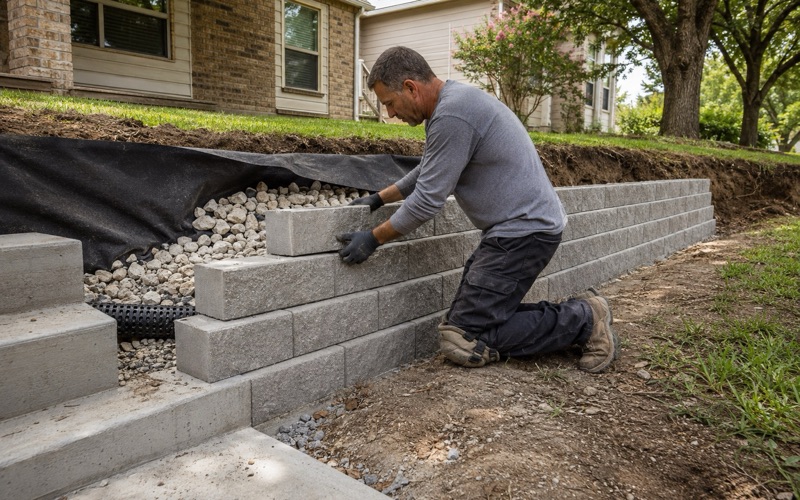
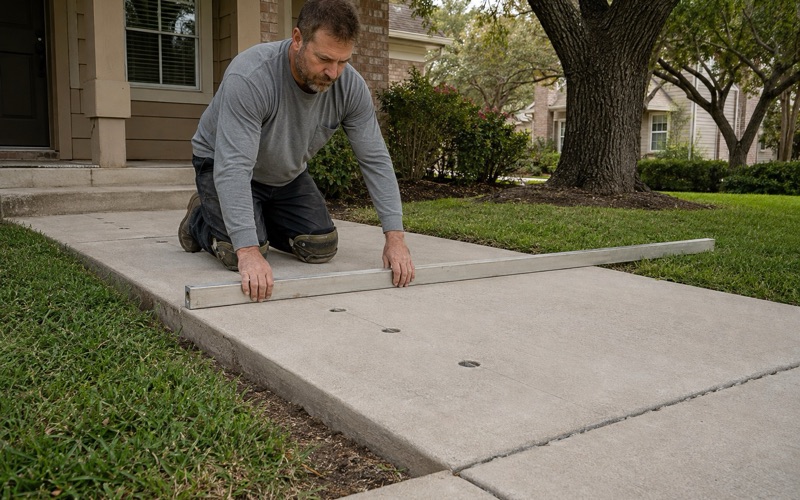
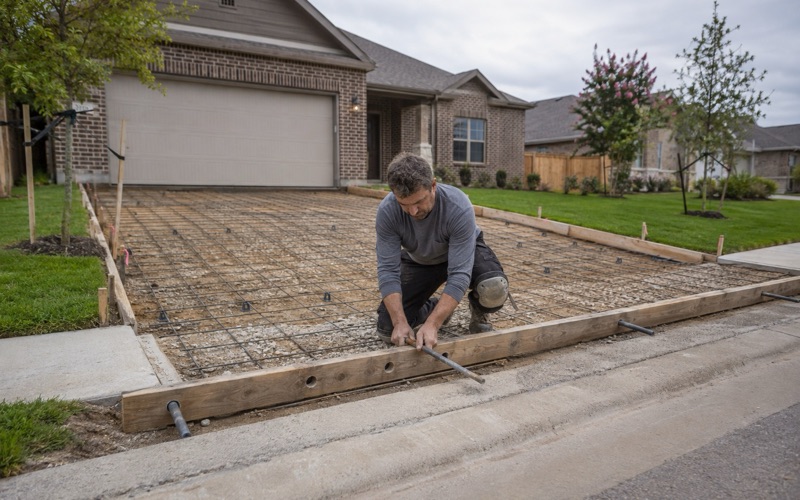
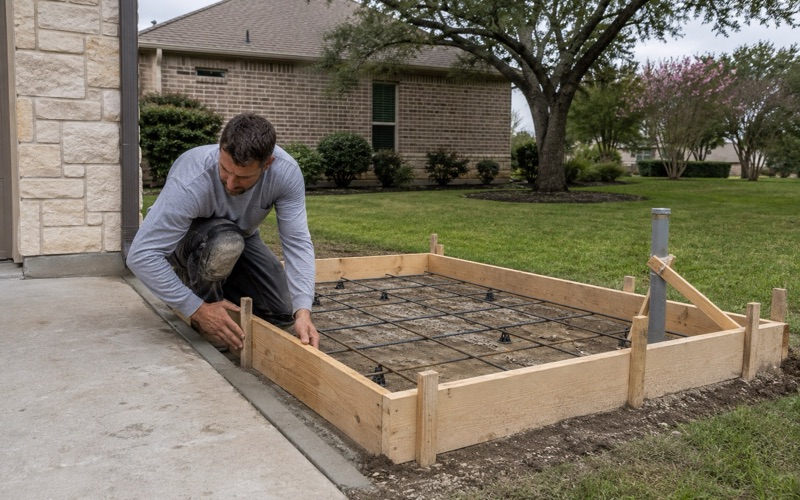
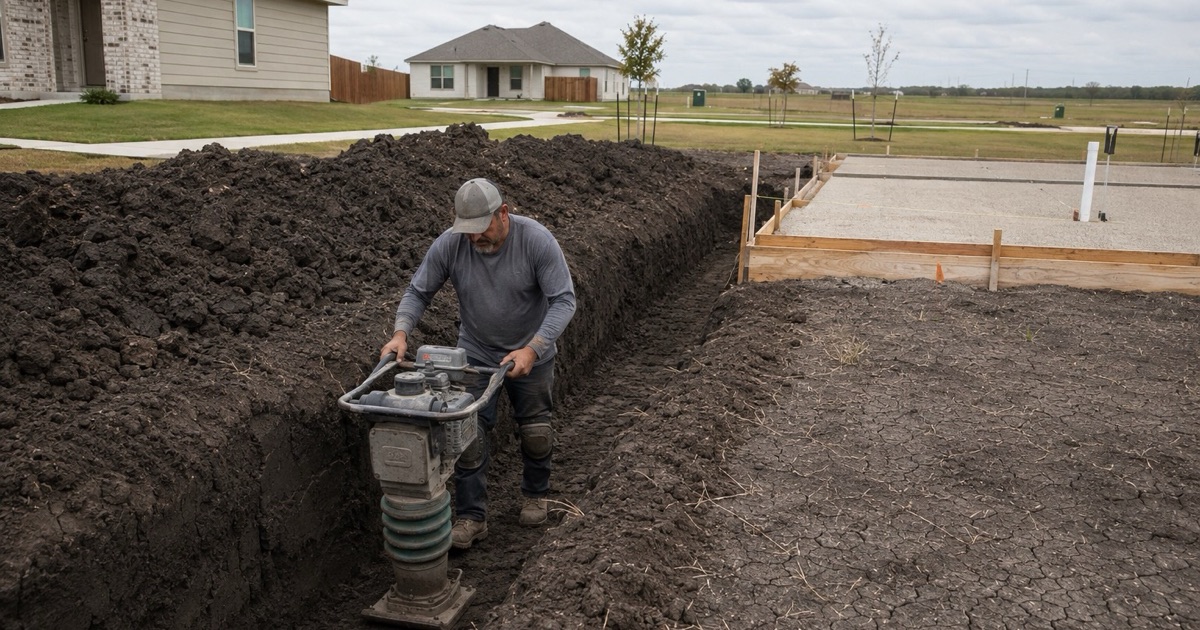
So the fundamentals get done in the right order: subgrade compaction verified before anything is placed, base course to a consistent depth, a vapor barrier where the use calls for it, reinforcement set on chairs instead of hooked up out of wet concrete, and control joints sawcut on the pour’s schedule rather than the crew’s. Hutto adopted the 2024 International Residential Code for One and Two-Family Dwellings alongside the rest of its 2024 code set, so what an inspector reads from is not a mystery to us.
The ground underneath it
Hutto sits on deep Blackland Prairie clay with no bedrock recorded in the profile. The town center and the northwest fall in the Branyon-Urban land complex on 0 to 3 percent slopes, whose plow layer carries a representative plasticity index of 39 and linear extensibility of 9.9 percent, rising to 43 and 13 percent in the horizon below. The southwest corner is Houston Black clay at a plasticity index of 44 to 45 and 12 percent linear extensibility.
The northeast is the exception, and it is materially different ground. In the Lewisville-Altoga complex the representative plasticity index drops to 20 in the plow layer and linear extensibility to as little as 3.1 percent. A reinforcement and joint plan that suits one side of town is not automatically right on the other, so we name what we are using for your slab, whether that is welded wire mesh, number four bar on chairs, or fibrous concrete.
Looking for concrete-contractor closer to Cedar Park? See Cedar Park Concrete-Contractor.
Contractor Registration Comes Before the Application
Every Hutto permit application is processed through the GovWell portal. The portal requires an account, and it requires the contractor registration process to be completed before the permit application forms can even be opened. Registration is not a step you finish alongside the application; it gates the application.
That ordering catches people out. A homeowner who plans to file on their own, or a crew from out of the county that has never worked inside the city, discovers the form is not available and the pour date slides by a week. We keep our registration current so the application is a same-week task rather than the start of a queue.
A housing stock built for the portal era
Hutto has 12,151 housing units and a median year built of 2010. Just under 94 percent of the stock went up in 2000 or later: 5,187 units in the 2000s, 3,776 in the 2010s and 2,446 in 2020 or later, against 251 units dating to 1939 or earlier. Nearly 93 percent of all units are single-family detached, and 79.6 percent of the 11,778 occupied units are owner-occupied.
Two things follow for flatwork. Most of the driveways, patios and walks we are asked to replace or extend here are attached to houses young enough that the original site drainage and lot grading are documented, which makes matching an existing slab straightforward. And a city that has been reviewing this volume of new residential construction for two decades runs its permitting the way it does for a reason. The town itself is much older than its houses, platted along the railroad right of way after a 50-acre sale in 1876, but almost nothing of that vintage is what a concrete crew works on today.
Starting early doubles the fee, by rule
The fee schedule states plainly that building permit fees double if work on the project begins before the permit issues. It is written as a rule of the schedule, not as a penalty someone decides to apply, and the city may also issue a Stop Work Order on a project that starts without approval.
There is no version of this where the fee is discussed after the fact: the schedule doubles it on the condition itself, and the condition is simply that work began first. On a $100 patio permit the doubled fee is small money, but a Stop Work Order landing on a job in progress is not. Concrete is the one trade where the work cannot be paused politely, because forms are set, a ready mix load is dispatched on a fixed window, and a slab that has begun curing under a stop order becomes a demolition line rather than a schedule delay. Waiting the extra days for the permit to issue is cheaper than every version of the alternative, which is the whole reason we file before we schedule.
Where Hutto Fire Rescue Enters the Review
Fire code review in Hutto belongs to Williamson County Emergency Services District No. 3, operating as Hutto Fire Rescue. It takes fire-related development applications directly, through its own portal at hfrpermits.com, rather than through the city’s system, and the fire safety inspection fee is set by the district rather than by the city.
The part that changes scheduling is how the two reviews interact. City plan review runs concurrently with the district’s, but no plans are approved until an ESD approval letter has been submitted for the project. On a project that carries a fire-related application, the city’s review finishing first does not release the job.
For a homeowner’s back patio that is usually not the path the application takes at all, and the point is simply knowing in advance which review a specific project triggers, so a fire-related letter is requested at the front of the job rather than discovered at the end of it. That matters most on commercial and site work, where a slab is tied to fire lane geometry, marking and access rather than to a back patio. Hutto publishes a fire lane marking sheet in its CH-ST street series of construction standards and details, current as of 10/01/2023, along with residential and commercial driveway sheets and a driveway aprons sheet. We name the sheet a piece of work is built to, and we send the district’s application in early on any job that needs one, because it is the letter, not the concrete, that sets the earliest honest start date.
Work in the Right-of-Way Is a Separate Application
Concrete that reaches past the property line into the public right-of-way is a second permit with its own fee line, and Hutto prices flatwork there separately from everything else. Right-of-way use for a driveway, flatwork, sidewalk or curb cut only carries a $100 application fee plus a $100 inspection fee on residential property, or $125 on commercial.
Everything other than a driveway, flatwork, sidewalk or curb cut carries a $500 application fee and inspections at $500 or $2.50 per linear foot of infrastructure item, whichever is greater. The description on the application is what puts a job on one line or the other, which is a good reason to have it written by someone who files these regularly. Right-of-way contractor registration is separate again, at $100 for one year or $175 for two.
Ninety days, and joints instead of dimensions
A right-of-way permit becomes null and void if construction has not commenced within 90 calendar days of issuance, and an extension can only be granted while the permit is still live. On a job waiting behind a design change or a neighbor’s schedule, that clock is the one to watch.
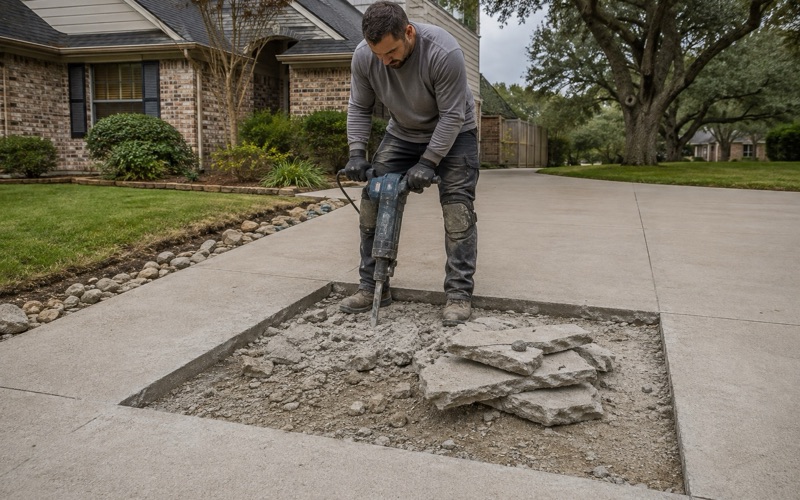
Where existing concrete has to come out, Hutto’s rules are written to joints rather than to measurements. Removal of existing pavement, drives, slabs and sidewalks requires a full depth sawcut with a power-driven saw, and the removal has to coincide with an existing sawed, construction or expansion joint so nothing is overcut. Any remaining surface damaged during removal is replaced to the nearest joint. Core holes may only be used to locate utilities and are repaired joint to joint, and three or more of them inside one panel of concrete pavement means the whole street panel is replaced.
Reading those rules before the saw comes out is what keeps a driveway replacement from turning into a panel replacement. We locate utilities through Texas 811, plan the cut lines to the joints that are already there, and quote the restoration that the manual actually requires rather than the one that would be convenient.
- 20+ Years in Georgetown
- Permits Pulled & Inspections Booked
- Free Written Estimates