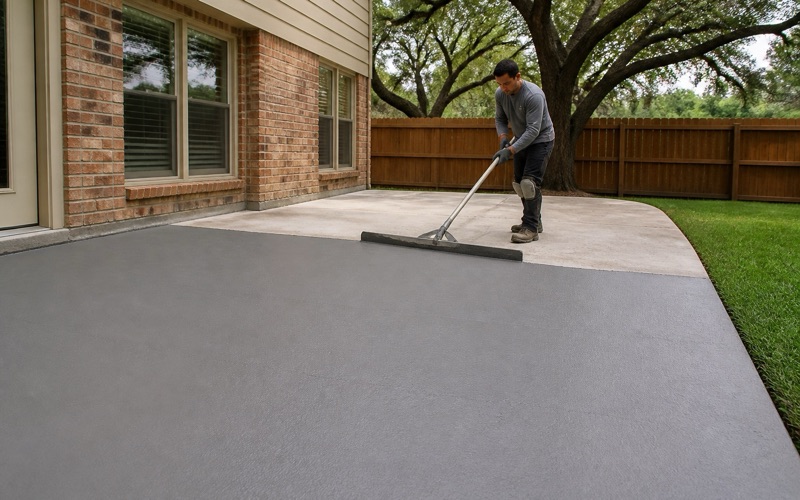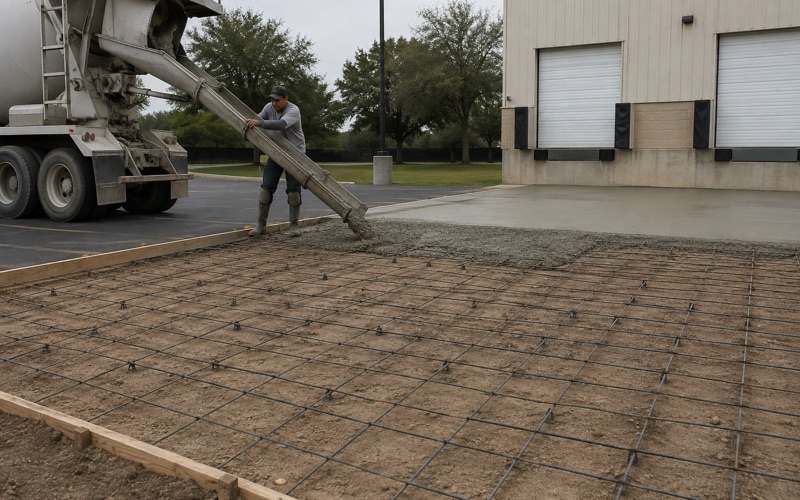
Georgetown Elite Concrete works as a concrete contractor in Killeen, repairing, replacing and resurfacing concrete and pouring new driveways, slabs, patios and walks. Twenty years and more of concrete across this region sits behind that, and the crew that assesses a failing slab is the crew that carries out the repair.
The thing that distinguishes concrete work in this city is how it treats repair. Structural repair here is permitted work rather than maintenance: Code section 8-23(a), amended into its present form by Ordinance No. 22-004 adopted January 25, 2022, requires a permit to make structural repairs including foundation repair.
Since January 1, 2026 there is a second layer on top of it. Ordinance No. 25-068, adopted December 2, 2025, brought the city onto the 2024 International Codes, and the local amendment at IRC section R106.1.1.1 requires engineered documents for structural repairs including foundation slab repair projects. A repair of that kind now arrives with drawings rather than with a written estimate.
Structural Repair Is Permitted Work Here
What Section 8-23(a) Requires
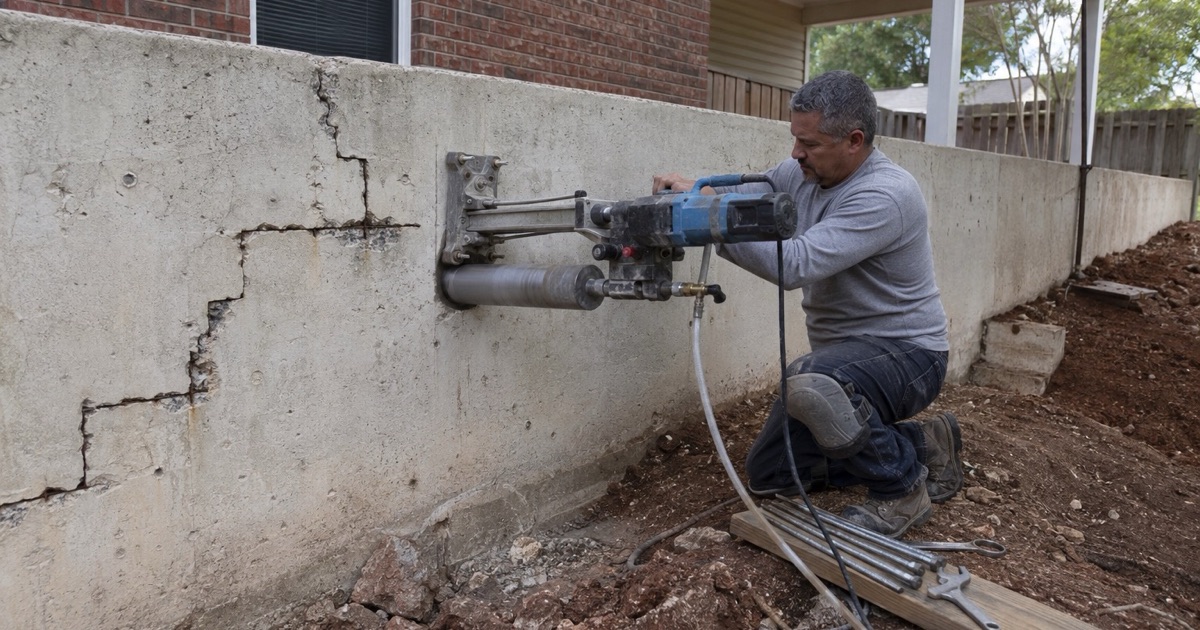
The provision requires a permit to make structural repairs, and it names foundation repair specifically rather than leaving it to be inferred. That places a category of work inside the permit system that many jurisdictions treat as maintenance.
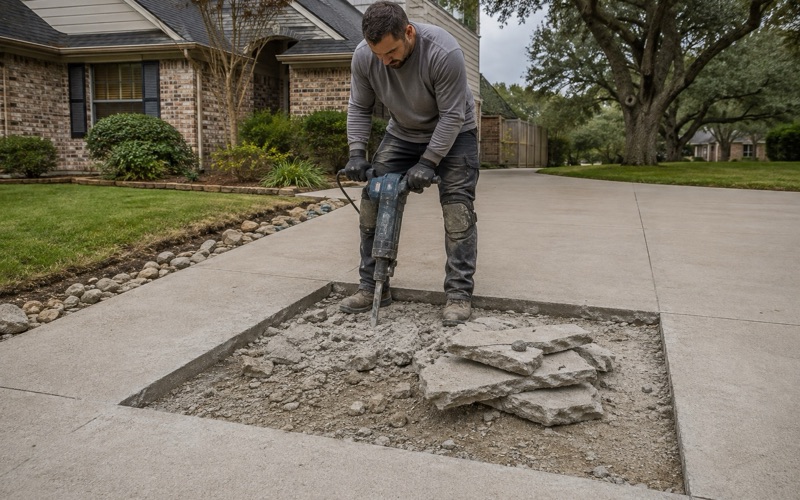
The distinction that matters is structural. Not every piece of concrete repair falls into the category, and it would be wrong to tell an owner that any crack treatment triggers a permit. What the rule reaches is repair of a structural kind, and identifying which side of that line a job sits on is the first assessment we make.
We make that call explicitly and say so in writing. An owner is entitled to know whether the work they are buying is permitted work, because it changes the timeline, the cost and the record left behind afterwards. It also protects them from the two opposite errors. A contractor who treats every repair as permitted work inflates a simple job, and one who treats none of it that way leaves an owner with unrecorded structural work on their property.
Why the City Treats It That Way
A jurisdiction that pulls foundation repair into its permit system is describing its ground as much as its administration. Repair work that is invisible once complete, on structures whose failure is expensive, is exactly the category where a permit and an inspection do the most good. That framing also protects the buyer. Permitted repair leaves a record, and a record is worth something at resale in a way that a paid invoice from an unrecorded job is not.
For a rental property that distinction matters more again. A quarter of occupied single-family detached houses here are rented rather than owner-occupied, so the person arranging the work is frequently not the person who will eventually sell it.
What Ordinance No. 22-004 Changed
Before that ordinance took effect on January 25, 2022 the position was different, so a contractor working from older habits or an owner recalling a previous job can easily be describing a rule that no longer applies. Dates matter here more than usual, because two separate changes have landed within four years. We work from the current text rather than from what was true on a previous project in the same city.
One further change in the 2024 package reaches slab work directly, with the under-slab vapor retarder requirement returning from 10 mil to 6 mil. It is a small specification point and exactly the kind that gets carried forward wrongly for years once somebody has learned it once.
Looking for concrete-contractor closer to Barton Creek? See Concrete-Contractor Services in Barton Creek.
Engineered Documents Since January 2026
What R106.1.1.1 Now Requires
The local amendment requires engineered documents for structural repairs including foundation slab repair projects, and for masonry or concrete columns, walls or retaining walls over four feet in height. That is a defined scope rather than a blanket requirement across all repair work.
It is worth being precise about that scope, because the overstated version circulates quickly. It is not the case that every concrete repair now needs an engineer; what it does mean is that the categories named carry engineered documents as part of the submission.
Where a job falls inside that scope we bring the engineering into the program from the start. Retrofitting a design onto work already priced and scheduled is the expensive way to satisfy a requirement that was knowable at the outset.
Walls Over Four Feet
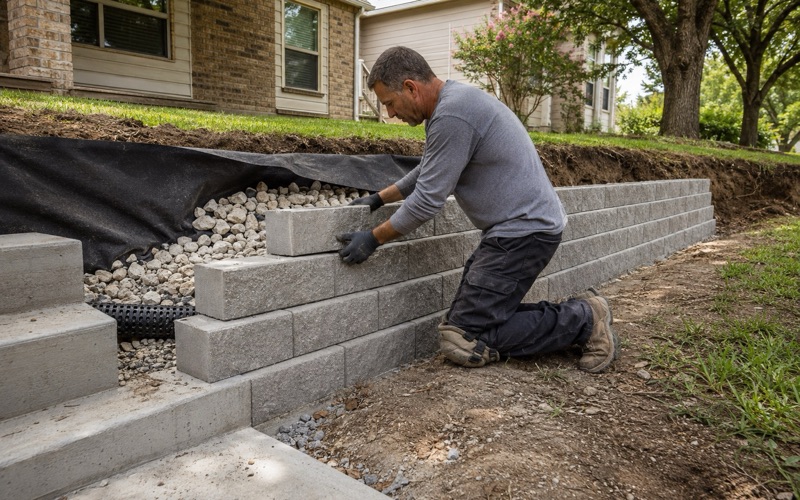
The same provision reaches masonry or concrete columns, walls and retaining walls over four feet in height. So a retaining wall repair here is measured against a height threshold in the same way a slab repair is measured against its structural character.
That threshold is worth checking rather than estimating, particularly where a wall steps or where the retained height differs along its length. A wall that is under four feet at one end and over it at the other is governed by what it actually is.
We measure retained height rather than exposed face, since those are not the same number and it is the structural condition that decides the requirement. Getting that wrong in either direction costs somebody money.
Planning a Repair Around the Requirement
The practical effect is that the assessment stage carries more weight here than in a city where repair is unregulated. Establishing whether a job is structural, and whether it needs engineered documents, is what determines the shape of everything after it.
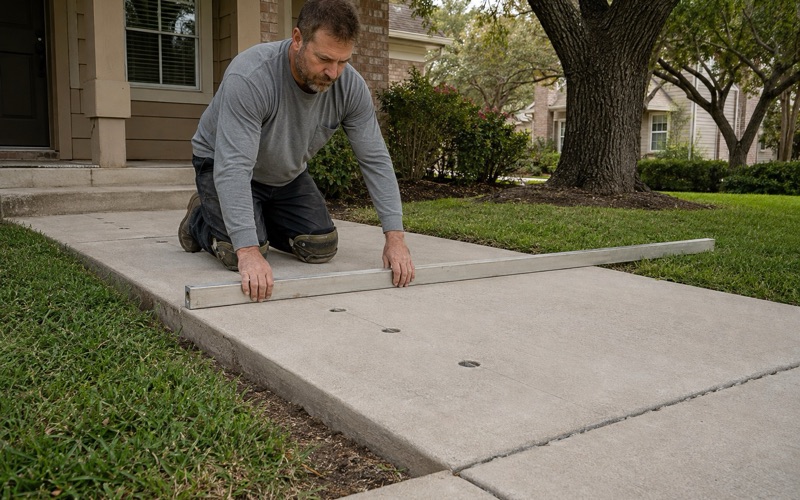
We do that survey properly and quote from it rather than from a walk-past. A repair quote that has not established which category the work sits in is a number rather than a proposal.
That is also the fairest way to compare bids. Two quotes for the same failing slab can differ enormously simply because one has assumed the work is unpermitted maintenance and the other has priced it as what it is.
What the Paperwork Costs and Requires
Construction Registration Before Anything Else
The city requires its own construction registration before a contractor may perform, contract to perform, or obtain a permit for permit-requiring work, at $80 a year. It is a prerequisite rather than a formality, and it applies to contracting for the work as well as performing it.
Section 8-61 places any contractor type not separately listed into the general contractor category, with a minimum comprehensive general liability policy of $100,000 per occurrence. Concrete is not separately enumerated, so flatwork registers under that general provision.
It is also worth saying that neither the city nor the state licenses concrete contractors as such. Registration and insurance are the checkable facts, and any claim of a concrete contractor license describes something that does not exist.
How Flatwork Itself Is Priced
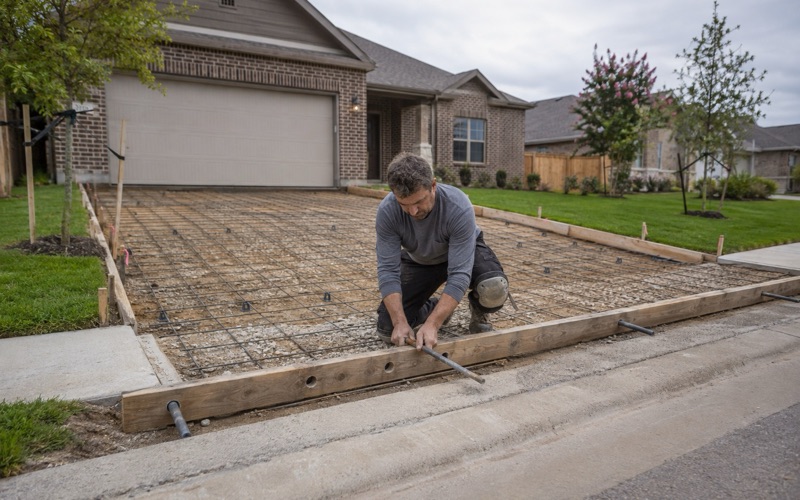
Flatwork is permitted by area here, at 11 cents per square foot with a $70 minimum, alongside a $10 technology and application fee. That is a transparent basis and it means the permit cost on a large drive is predictable rather than discretionary.
Inspection outcomes carry their own fees, with a failed inspection at $50 and a partial inspection at $35. Those are avoidable costs, and they are avoided by having the work genuinely ready when an inspection is called rather than hoping.
Permits and inspections here run through the city’s online portal, which makes the status of a job visible rather than something to be chased by telephone. We use it to sequence pours against inspections rather than the other way around.
Where Accessibility Review Enters
Construction over $50,000 is routed to the Texas Department of Licensing and Regulation for accessibility review under the city’s submittal guidance. On commercial work that threshold arrives sooner than people expect once a whole scheme is counted.
We check the project value against it at tender rather than at submission, since the review is a process with its own duration. It is a scheduling item rather than a document to be produced at the end.
Repair, Resurface or Replace
Making the Decision Honestly
With repair inside the permit system, the choice between repairing, resurfacing and replacing carries consequences beyond price. A structural repair brings drawings and inspections; a straightforward replacement of a failed drive is a different transaction.
We set out all three with what each involves, because the cheapest option on the invoice is not always the cheapest over ten years. Where a slab has enough sound material and stable support, repair or resurfacing genuinely wins.
Where it does not, we say so plainly. Money spent structurally repairing a slab that has lost its edges and is cracked through in several places is money spent on the way to replacing it anyway.
What the Ground Contributes
Conditions vary sharply across this city rather than grading evenly, and depth to rock differs lot to lot inside a single subdivision. That variability is why a repair diagnosis has to be made on the property rather than from the pattern of the cracking alone.
The dominant soils here are expansive by the residential code’s own test while being shallower and less extensible than the deep clays east of the city. That combination tends to produce differential support rather than uniform heave, which is a different failure to design a repair against.
Roughly a third of the mapped area inside the city limits is shallow to rock, and the depth changes from lot to lot. A slab bearing partly on rock and partly on soil is being supported two ways along its own length, and a repair that does not account for that reopens in the same place.
Getting the Preparation Right
The city’s own infrastructure specification puts moisture control in writing, requiring the subgrade to be excavated and shaped, hand tamped and sprinkled where the city considers it necessary, and to be moist at the time the concrete is placed. That is a useful standard to hold private work to as well.
Killeen is the largest city in Bell County with a population of 153,095 at the 2020 census, and 14,001 of its housing units, 21.3 percent of the stock, were built between 2000 and 2009. That cohort’s original driveways, walks and patios are now roughly two decades old, which is why assessment and repair rather than new construction is the larger part of the work here.
- 20+ Years in Georgetown
- Permits Pulled & Inspections Booked
- Free Written Estimates