Georgetown Elite Concrete works as a concrete contractor in Lost Creek, replacing and repairing driveways, walks, patios and slabs, and leveling and resurfacing concrete that is still worth keeping. Twenty years and more of concrete across this region sits behind that, and the people who assess an old slab are the people who take it out and pour the new one. Almost every job here is replacement rather than new construction, and the housing data says why. The five-year American Community Survey records 424 housing units with a median year structure built of 1977: 121 units built in the 1960s, 137 in the 1970s, 62 in the 1980s, 52 in the 1990s, 40 in the 2000s, 12 in the 2010s, and none built in 2020 or later.
So the original concrete across this place is between about fifty and sixty-five years old, and it is nearly all sitting on lots that have been lived on and landscaped around ever since. That changes what the work is: less pouring on open ground, more careful removal and replacement in a finished setting.
Fifty-Year-Old Concrete on a Finished Lot
What the Housing Numbers Say About the Work
Of the occupied units here, 358 are owner-occupied single-family detached houses, which is 84.4 percent, and 381 of the 424 total units are detached. That is an unusually uniform stock, and it means the addressable work is essentially one kind of property rather than a mix. It also means the flatwork is broadly the same age and the same original specification across the place. Driveways, front walks and porch slabs put down when these houses were built are reaching the end of a service life together rather than one street at a time.
The practical consequence is that a homeowner asking whether their drive is unusually bad usually is not looking at an unusual failure. They are looking at concrete that has done its job for five decades. Knowing that changes the conversation from repair to planning. Once a drive, a front walk and a porch slab are all of an age, the sensible question is what order to replace them in and whether doing two together saves a second mobilization.
A Neighborhood That Stopped Adding Units
With 12 units added in the 2010s and none since 2019, this is a built-out place. There is no subdivision-scale new pouring to be done, and no phase of new construction against which replacement work competes for access or scheduling.
That has a real effect on how a job runs. Every project is a single property with neighbors either side who are not themselves under construction, and the standard of tidiness and noise management that implies is different from working on a development.
It also means there is no site compound to work from. Materials, plant and debris all have to live on the property being worked on for the duration, which is a planning constraint on a wooded lot with one access.
Why Replacement Is the Honest Recommendation
On concrete of this age the useful question is rarely whether a crack can be filled. It is whether the slab as a whole has enough sound material and enough remaining life to justify spending money on part of it.
We are direct about that, because a repair on a fifty-year-old drive frequently buys a season or two and then has to be done again as part of the replacement anybody could see coming. Where a slab genuinely is worth keeping we say that too, and lifting or resurfacing is the cheaper answer.
Median owner-occupied value here is $1,163,100, which tends to mean the finished result matters as much as the price. That argues for doing the job once, properly, rather than staging repairs that will be demolished later.
Looking for concrete-contractor closer to Harker Heights? See Concrete-Contractor in Harker Heights.
How Original Flatwork of This Era Fails
What Goes First
On a drive of this age the edges usually go before the field. Slab edges are unsupported on one side, take wheel loads at their weakest point and shed the water running off the whole surface, so they spall, break back and lose their line long before the middle of the slab is in trouble.
Joints are the other early casualty. Filler hardens, shrinks and drops out over decades, at which point the joint stops absorbing movement and the adjacent concrete begins taking load it was never meant to carry.
Surface loss is the third pattern, and on concrete this old it is usually the finish wearing through rather than a defect appearing. Once the surface paste has gone the aggregate is exposed to everything, and deterioration accelerates from that point rather than continuing steadily.
Reading Whether It Is Worth Repairing
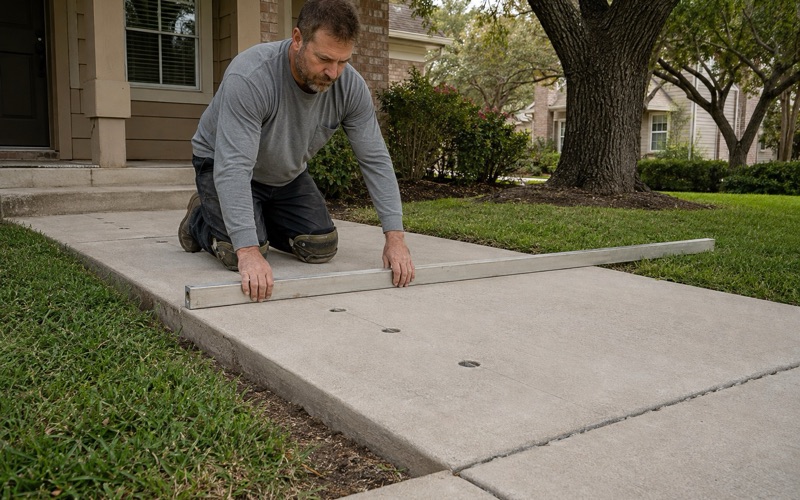
The assessment is about how much sound concrete is left and whether it is still uniformly supported. Isolated cracking, intact edges and a slab breaking at its joints rather than across panels all point toward a slab worth keeping.
Cracking through the depth in several places, panels that rock underfoot, lost edges throughout, or surface loss over large areas all point the other way. We sound the slab and look at the pattern rather than the worst single defect, because one dramatic crack is often less serious than widespread quiet deterioration.
We also look at what is under it where we can. A slab that is failing because its support has gone will keep failing after replacement unless the ground is addressed, and finding that out at assessment is considerably cheaper than finding it out twice.
Replacing a Run Rather Than a Panel
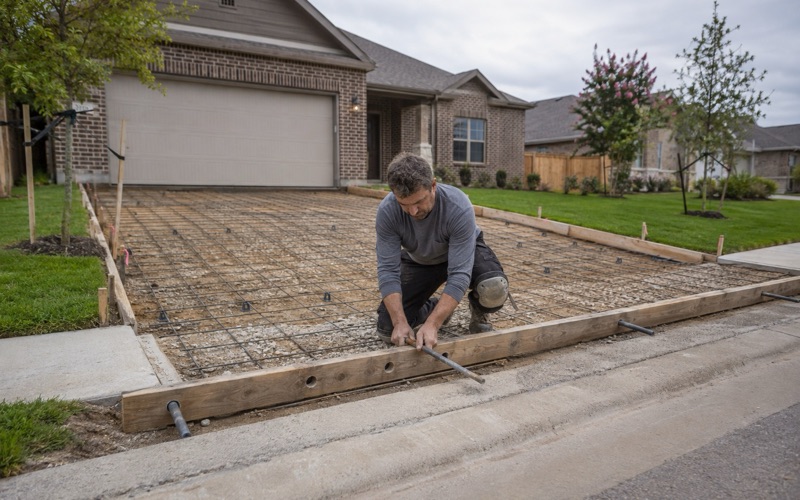
Where replacement is right, the scope question is how much. Replacing a single failed panel is cheapest on the day and frequently reads as a patch afterwards, because new concrete will not match fifty-year-old concrete for a long time.
Replacing to a natural break, a joint line, or the full run gives a result that reads as one surface. We price both and explain what each will look like, so the decision is made on appearance and budget rather than by default.
Tear-Out and Haul-Off on a Finished Property
Removing Concrete Without Wrecking What Is Around It
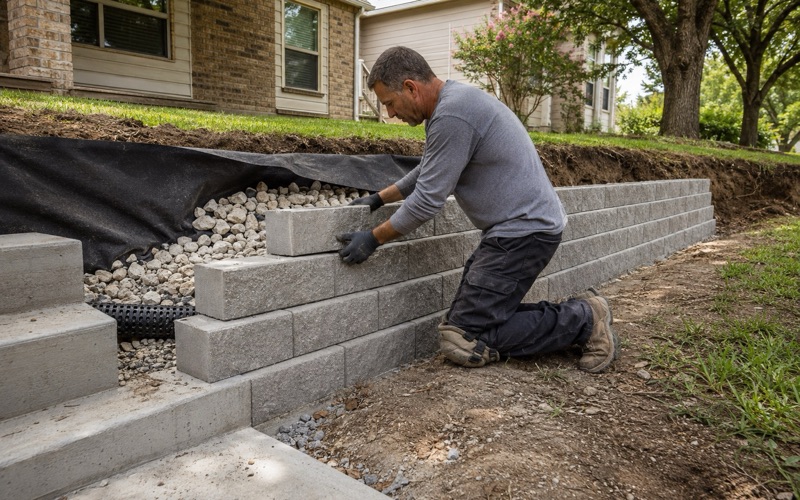
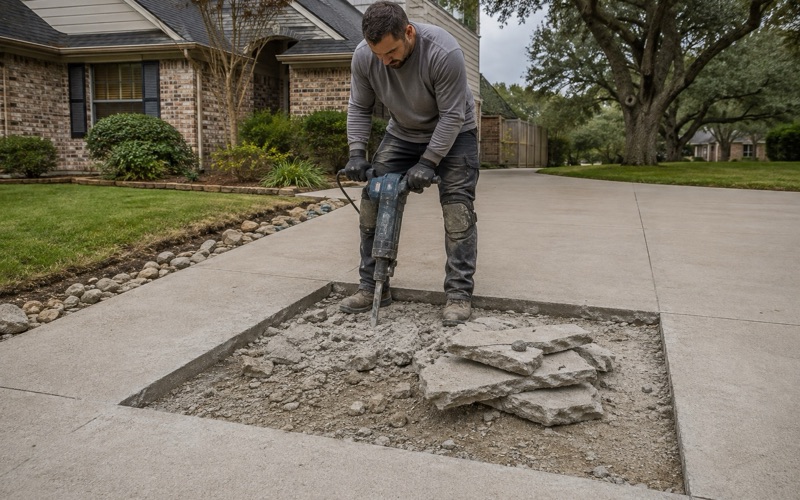
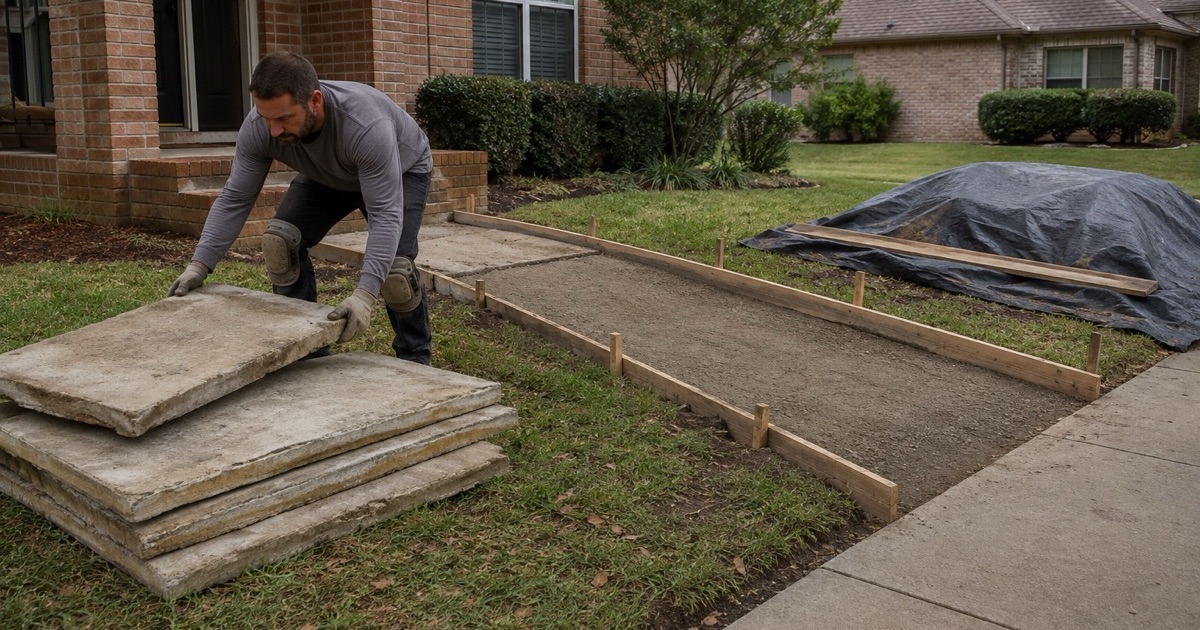
On a lot that has been established for decades, demolition is the delicate part of the job rather than the crude part. Mature planting, irrigation, lighting, established beds and hard landscaping have all arrived after the concrete and frequently sit right against it.
We survey what is adjacent before breaking anything, protect what stays, and choose the method accordingly. Breaking a slab out in controlled sections costs more time than dropping a machine on it and costs far less than reinstating a garden.
Irrigation is the item most often damaged, because lines run close to hard surfaces and are rarely recorded. We ask for whatever the owner has and probe where we expect a line rather than trusting that a break will be obvious when it happens.
Debris, Washout and a Private Waste Subscription
Broken concrete is heavy and voluminous, and here it cannot simply go out with a municipal collection, because solid waste in this place is a private subscription rather than a city route. Demolition debris and concrete washout are therefore contractor responsibilities to plan and price properly.
We arrange removal as part of the job and manage washout so it does not end up in a bed, a drain or a watercourse. On a wooded property draining toward a creek that is not a formality, and it is one of the places a cheap quote quietly makes itself cheaper.
Utilities That Belong Elsewhere
There is a genuine oddity to work with here: water and wastewater are provided by Austin Water and electricity by Austin Energy, even though the street and the property are not in the city. A meter box, a service line or a cleanout met during excavation therefore belongs to a city utility.
That matters at the moment something is found rather than in the abstract. We locate before digging and treat anything encountered as belonging to somebody who must be contacted, rather than as an obstruction to be worked around.
Matching an Established House
Color and Finish Against Weathered Concrete
New concrete does not match old concrete, and anybody promising otherwise is guessing. Color depends on the mix, the age, the curing and the finishing pass, and fifty years of weathering cannot be reproduced on the day of a pour.
What can be controlled is everything else: the finish type, the direction a broom is worked, the texture and the joint pattern. Matching those makes a new run read as deliberate rather than as a repair, and the color difference narrows over the following seasons.
Edges, Levels and a Landscape That Grew Around the Slab
On a lot landscaped over decades, the existing slab has become the datum for everything beside it. Beds, borders, steps and paths have been built to its level, so lifting or lowering a replacement by even a small amount has consequences in every direction.
We record existing levels before demolition and rebuild to them unless there is a good reason to change, in which case we say what else will need adjusting. The commonest complaint about replacement flatwork is not the concrete but the step that appeared beside it.
Access, Trees and Staging a Narrow Drive
These are wooded, sloping, high-value lots, and the drive being replaced is frequently the only access to the property. That makes staging a real design problem: where the truck stands, where the breaker works, where debris goes and how the household gets in and out while it happens.
Mature trees add a further constraint, both above and below ground. Root zones do not appreciate plant standing on them and canopy decides what can physically reach a pour, so we plan the sequence around the trees rather than discovering them on the morning.
Lost Creek is an unincorporated community in Travis County served by Eanes Independent School District, made up of several small neighborhoods including Parkstone, Woods of Westlake, Camelot and Knollwood. Where a household cannot lose vehicle access for the full duration, we sequence a drive in halves and say plainly what that adds, because on a single-access lot that is a question about daily life rather than about concrete.
- 20+ Years in Georgetown
- Permits Pulled & Inspections Booked
- Free Written Estimates