Georgetown Elite Concrete works as a concrete contractor in Manor, pouring driveways, slabs, patios, walks and commercial flatwork, and repairing, leveling and resurfacing concrete already in the ground. Twenty years and more of concrete across this region stands behind the work, and the crew that assesses the subgrade is the crew that places the concrete on it.
Most towns give a contractor a mixed picture to read. This one does not: a 159-point grid clipped to the city polygon and queried against the Travis County soil survey returns a Vertisol as the dominant component at 100.0 percent of points, and hydrologic soil group D at 100.0 percent of points. Every acre of this city is deep expansive clay in the highest-runoff, lowest-infiltration class the survey assigns.
That uniformity is genuinely useful, because it means the design problem is the same everywhere and can be solved properly rather than guessed at per lot. It also means two things are true of every job here: the ground moves with its moisture, and water does not soak away. Everything below follows from those two facts.
What Houston Black Clay Does Under a Slab
The Numbers, and Why Both Matter
Houston Black clay is the dominant component at 71.7 percent of sampled points, carrying a representative plasticity index of 44 to 45, a liquid limit of 70 to 71, 54 to 55 percent clay and linear extensibility of 12 percent. Those are high figures on both measures at once.
Elsewhere in this region a high plasticity index is frequently paired with low linear extensibility, which means the material behaves less dramatically than the first number suggests. That is not the case here. Both readings point the same direction, so the ground genuinely moves rather than merely testing as though it might.
Heiden clay at 9.4 percent of points and Ferris at 6.9 percent tell the same story with slightly different figures, Heiden running linear extensibility of 10 to 12.2 percent and Ferris reaching as high as 17 percent. Only four series appear across the whole city, in seven map units, and none of them is a soil that stays still.
Seasonal Movement Under Flatwork
A slab on ground like this is sitting on material that swells as it takes up water and shrinks as it dries, and the movement is not uniform across a driveway because the moisture is not uniform either. Edges dry faster than centers, and ground under a slab holds moisture that adjacent open ground loses.
That differential is what cracks flatwork here, rather than the total amount of movement. A slab that rose and fell evenly would be largely unaffected; one supported by ground that is wet at one end and dry at the other is being bent.
The practical response is to reduce the differential and to control where the slab relieves itself. Consistent subgrade moisture at placing, thickened edges where they earn their place, and a deliberate joint layout do more for a driveway on this ground than extra thickness alone.
Moisture Condition at the Time of Placing
Because the clay’s behavior is governed by moisture, the condition of the subgrade on the day is a real decision rather than a matter of convenience. Placing concrete over clay that is unusually wet or unusually dry locks in a starting condition the slab then has to live with as the ground returns to normal.
We treat that as a scheduling constraint with the same standing as a delivery date. Working a saturated subgrade also damages its structure, which makes the support worse in a way no amount of finishing can recover.
Looking for concrete-contractor closer to Steiner Ranch? See Concrete-Contractor in Steiner Ranch.
Excavation With Nothing To Hit
Why Refusal Never Sets the Price
Not one dominant component in the sample carries a lithic or paralithic restriction at any depth. The only restrictions recorded anywhere are densic materials at 91 to 147 centimeters and deeper, which is well below where flatwork excavation goes.
So the usual excavation risk in this region simply is not present. A trench here is priced by how the clay behaves the day it is open rather than by how deep a machine can get before something stops it, and that is a very different quotation.
It also removes a common source of dispute. Where excavation cost is set by refusal, quotes carry contingency and arguments follow; where the material is known and consistent to depth, the excavation line can be priced honestly and held.
What Actually Drives Excavation Cost
Wet clay and dry clay are different materials to work. Dry, it is hard and slow; wet, it is heavy, sticky and prone to being smeared rather than cut, and it fouls plant and haulage in a way that costs real time.
Trench stability is the other variable, since these are deep, uniform clays with no coarse fraction to hold a face. We plan excavation around the condition we expect rather than assuming ideal ground, and we say what would change if conditions on the day are materially different.
The Footing Depth the City Names
The city amends the residential design criteria table for local conditions, setting a frostline depth of 12 inches along with a 90 mile per hour design wind speed, a 5 pound per square foot roof snow load and a 28 degree winter design temperature.
That 12-inch figure is the number a footing detail answers to here, and it is a useful anchor precisely because there is no rock to establish a depth for you. On ground with no refusal, depth is set by requirement and by bearing rather than by what the machine finds.
Hydrologic Group D and Water That Stays Up
Saturated Hydraulic Conductivity of 0.21
Houston Black, Heiden, Ferris and Tinn all carry a saturated hydraulic conductivity of 0.21 micrometers per second, which is at the low end of the scale. In practical terms water moves through this ground very slowly indeed.
Combined with hydrologic soil group D across 100.0 percent of sampled points, that means every drainage problem has to be solved on the surface. Ground that would soak away a modest amount of runoff in other places simply does not do so here.
Every New Slab Is Runoff
A driveway or a patio on this ground converts almost everything landing on it into surface water, and the ground next to it will not absorb much of that either. So the question is never whether water leaves the slab but where it goes afterwards.
We work the destination out as part of the design rather than leaving it to the fall of the yard. Discharging onto adjacent ground here frequently relocates a puddle rather than removing one, and sometimes moves it onto a neighbor.
Positive fall away from any structure is the non-negotiable part. On ground that both moves with moisture and refuses to drain, water standing against a foundation is the mechanism behind a large share of the damage we are called to look at.
Grading on Very Flat Ground
Much of the ground here sits on gentle slopes, and the frequently flooded bottomland unit on the western flank is mapped at 0 to 1 percent. Creating fall on ground with almost none is deliberate work that has to survive construction traffic and be checked before the pour.
We set levels with instruments and re-check them once the forms are set. A slab that reads level to the eye on flat ground can easily be running the wrong way by a small amount, which is enough to matter when the receiving ground takes no water.
Bottomland, Flood Mapping and Building For It
Tinn Clay on the Western Flank
Tinn clay, 0 to 1 percent slopes, frequently flooded, covers 11.9 percent of sampled points, and both the northwest and southwest sample points return it. That phrase is the soil survey’s own map unit name rather than a characterization borrowed from a flood map.
Tinn carries a plasticity index of 41 and linear extensibility of 9.3 to 10 percent with no restrictive layer to 204 centimeters, so it is deep, mobile and slow-draining like the rest, with a landform position that adds seasonal wetness on top.
What the Flood Mapping Adds
FEMA’s mapping puts 20.1 percent of the sampled points inside a Special Flood Hazard Area, made up of 10.1 percent Zone A, 7.5 percent Zone AE and 2.5 percent inside the regulatory floodway, with the remaining 79.9 percent in Zone X, an area of minimal flood hazard.
The awkward part is the Zone A share, because Zone A carries no published base flood elevation. On that tenth of the city an elevation cannot simply be looked up the way it can in Zone AE, so establishing it becomes part of the work rather than a reference check.
We establish position from the official mapping before designing levels, and we do not offer opinions on a particular property’s flood status, which is a determination that comes from the mapping rather than from a contractor.
Building a Driveway on Ground That Moves
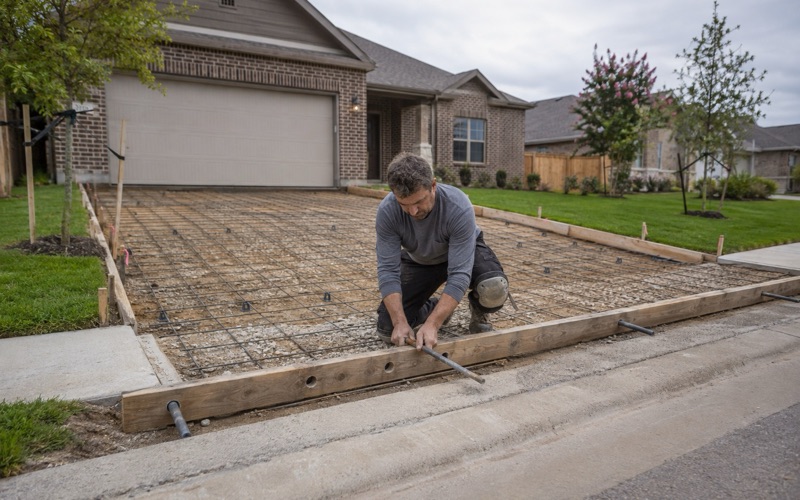
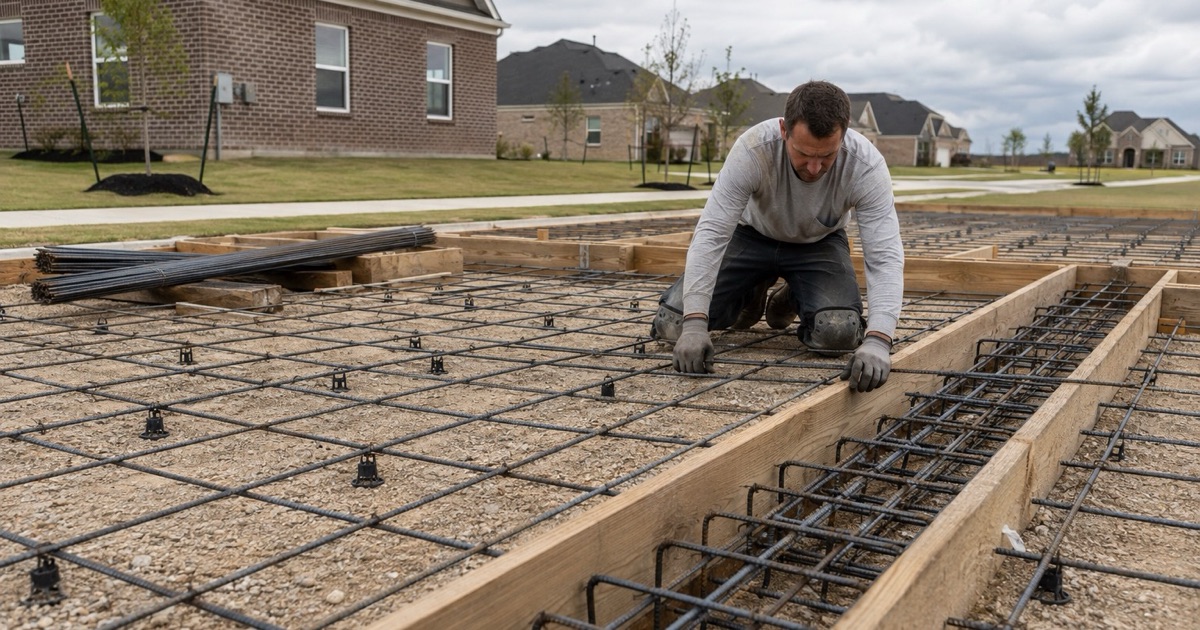
Everything above converges on the same set of decisions: a subgrade prepared to a consistent moisture condition, a base that gives uniform support rather than bridging soft spots, reinforcement held at its designed depth, a joint layout that chooses where the slab cracks, and falls that take water somewhere it can actually go.
Manor sits about 12 miles northeast of Austin and has grown quickly, with more than a quarter of its housing stock built since 2020 and a small pre-1980 core behind it. That produces two quite different jobs: early-life problems on new slabs, and full replacement of flatwork that has spent forty years on ground like this.
There is also a real multifamily and managed-property market here, with 8.7 percent of the stock in structures of fifty units or more, which means parking areas, dumpster pads, walks and accessible ramps sitting on exactly the same clay. The engineering answer does not change with the ownership; only the phasing does.
- 20+ Years in Georgetown
- Permits Pulled & Inspections Booked
- Free Written Estimates