Georgetown Elite Concrete provides polished concrete in Georgetown, TX, backed by more than twenty years of concrete work across Williamson County and jobs in surrounding cities including Serenada, Santa Rita Ranch, Round Rock, Brushy Creek and Jarrell. Polishing is a mechanical process rather than a coating: the floor you end up with is the slab you already own, ground and refined until it reflects light on its own.
That distinction decides everything about whether a floor is a candidate. A coating can hide a poor surface, while polishing can only reveal what the slab actually contains, including its aggregate gradation, its finishing history, its patches and any staining that reached into the paste. We assess the slab honestly before quoting, because a polished floor is a permanent decision about a surface you cannot un-grind.
It also means polishing suits some slabs beautifully and others not at all. New pours can be specified for it from the start, and existing slabs are judged on what a test panel shows rather than on how they look under a layer of old sealer or adhesive.
The Two Choices That Decide How It Looks
Aggregate Exposure, From Cream to Full Stone
The first cut decides what the floor shows. A cream finish grinds only the surface paste and displays almost no stone, a salt-and-pepper exposure reveals the fine aggregate as a speckle, and a full exposed aggregate cut goes deep enough to display the large stone as a terrazzo-like field. These are three genuinely different floors from one slab, and the choice is irreversible once the cut is taken.
Gloss Level and How Much Light It Returns
Gloss is a separate decision from exposure and comes from how far the grit sequence is carried, from a matte satin through to a high reflective finish. Higher gloss returns more light and makes a space read brighter, and it also shows every scuff, every wheel mark and every gap in maintenance. We match the gloss to how the floor will actually be cleaned rather than to how it looks on the day.
Densifying and Why the Floor Holds Its Shine
Between grinding stages a chemical densifier is applied that reacts within the concrete to harden the surface from inside. That reaction is what makes a polished floor durable and abrasion resistant rather than merely smooth, and it is why polishing produces a wearing surface rather than a temporary sheen. Skipping or short-changing that step is the usual reason a polished floor dulls within a year.
Reading the Slab With a Test Panel
We grind a sample area before committing to a specification, because the aggregate gradation, the depth of the cream layer and the presence of patches or power-trowel burnish marks are only knowable by cutting into the actual floor. That panel is also the most useful thing a client sees, since it shows the real floor rather than a photograph of somebody else’s.
Where Polished Concrete Belongs
New Slabs Specified for Polishing
When polishing is decided before the pour, everything gets easier and cheaper. The mix can be chosen for its aggregate, the placement and finishing can be planned for a flat consistent surface, penetrations and joint layout can be positioned deliberately, and there is no old coating or adhesive to remove. We plan a floor for polishing at the slab design stage wherever the client knows early enough.
Existing Slabs and Retrofit Floors
An existing slab can polish superbly, and the variables are what is on it and what is in it. Old adhesive, coatings, curing compounds and patches all have to come off or be accounted for, and a slab with deep staining or a great deal of remedial work may look busier than the client expects. The test panel settles it rather than a discussion.
Garages, Workshops and Light Commercial Floors
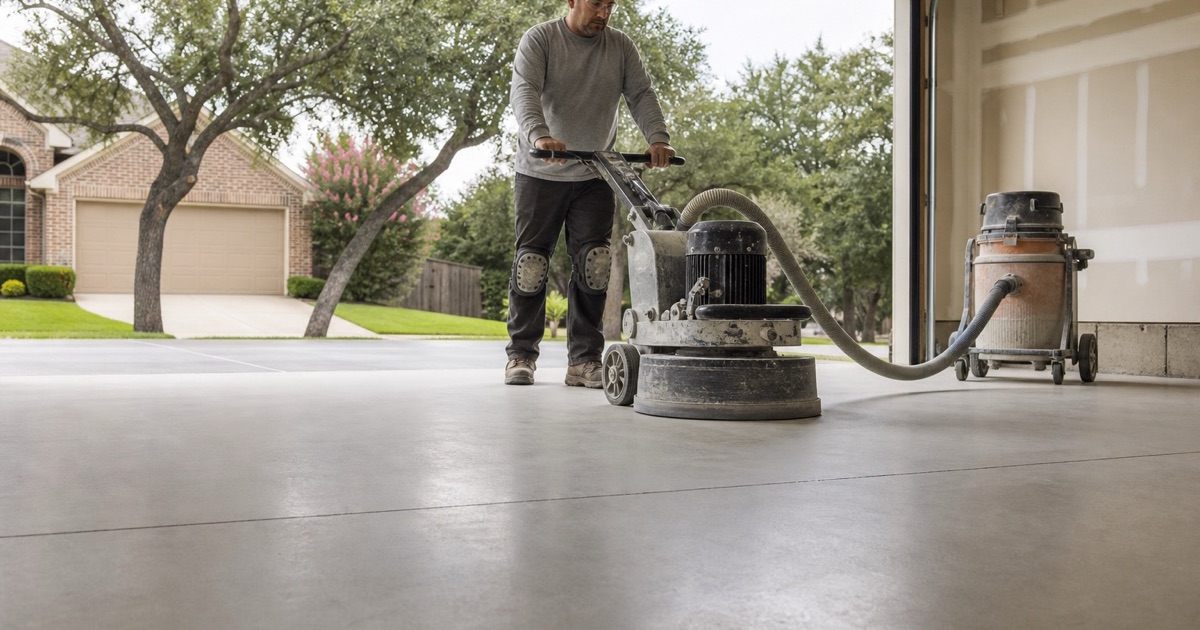
Polished concrete suits spaces where a floor takes wheeled traffic and needs to be cleaned easily rather than one that needs to be soft underfoot. Because it is the slab rather than a film on top of it, there is nothing to delaminate under a hot tire or a dragged pallet. ACI 302.1R floor classes are a useful shared language here for setting the flatness expectation before work starts.
When Another Finish Is the Better Answer
Where a slab is badly cracked, heavily contaminated, uneven enough to need substantial grinding, or simply not the floor the client hopes it is, a self leveling underlayment with a different finish, or a resurfacing system, will give a better result for less money. We say so, because a polished floor sold onto the wrong slab disappoints permanently and cannot be reversed.
Living With a Polished Floor
Cleaning and Routine Maintenance
A polished floor is cleaned with a neutral cleaner and a flat mop or an autoscrubber, and it dislikes acidic cleaners, which etch the surface it took a grit sequence to produce. Maintenance is genuinely light, but it is specific. We hand over a written routine, because the most common cause of a dull polished floor is an enthusiastic cleaning product rather than wear.
Slip Resistance and Where to Be Careful
A polished floor is not inherently dangerous dry, and it is like any hard smooth surface when wet. That matters at entrances, beside sinks and anywhere water arrives, and it is worth planning matting or a change of surface at those points. Where a household or a workplace needs more certainty, the gloss level can be pulled back deliberately to trade reflection for grip.
Joints, Cracks and Honest Expectations
Polishing does not remove control joints, and it does not hide existing cracks; it makes both more visible by making everything around them cleaner. Joints can be filled with a semi-rigid filler so they read as lines rather than gaps, and cracks can be stabilized and filled, but neither disappears. We show you what those will look like on the test panel rather than describing them afterwards.
- 20+ Years in Georgetown
- Permits Pulled & Inspections Booked
- Free Written Estimates