
Georgetown Elite Concrete installs stamped concrete in Georgetown, TX, drawing on more than twenty years of decorative and structural concrete across Williamson County and serving surrounding cities including Serenada, Santa Rita Ranch, Round Rock, Brushy Creek and Jarrell. Stamped concrete takes a fresh slab and presses pattern and color into it while it is still workable, so the decoration is part of the concrete rather than something laid on top of it.
The first question on any stamped job in this city is not what pattern you want. It is whether your address is allowed to have one. Inside Sun City, section 3.15 prohibits coatings producing a stamped or template pattern and any definite multi color appearance, and reserves aggregate and stamped concrete to Custom Homes, which puts a genuine stamp out of reach for most residents there.
That is not the end of the conversation, because the association permits a real decorative vocabulary by another route. We establish which covenant, overlay or none at all governs your property before we quote a pattern, so nobody pays a deposit on a finish they will later be required to remove at their own cost.
How a Stamped Concrete Job Is Built
Color: Integral, Hardener or Both
Integral color pigments the whole batch, so the color runs through the slab and a chip or a saw cut does not expose gray concrete. A color hardener is broadcast onto the surface and worked in, giving a denser, harder wearing face and stronger color than integral pigment alone. Each has a place, and on a drive that will take real wear we frequently specify both rather than choosing between them.
Release Agent and the Second Color
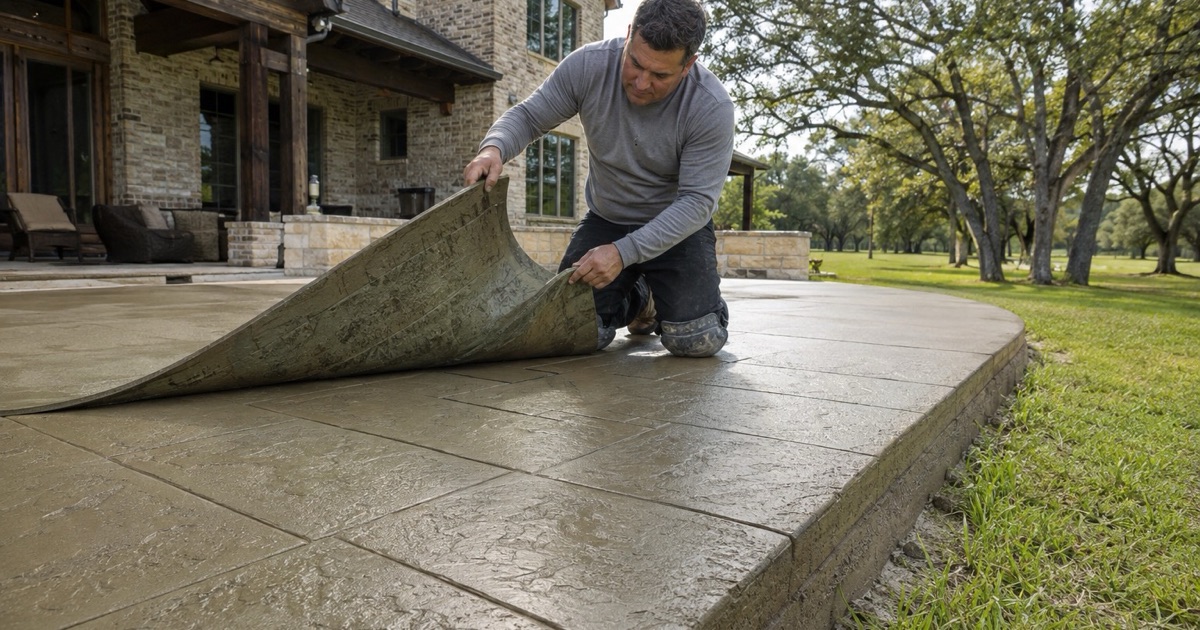
A release agent stops the mats sticking to fresh concrete and, when a colored powder release is used, deposits an accent tone that settles into the low points of the texture. That secondary color is what stops a stamped surface reading as a single flat sheet of pigment. How much survives the wash and the seal is a judgment call made on the day, and it is the difference between depth and a printed look.
Stamping the Slab in Its Window
Stamping happens inside a window that opens when the slab is firm enough to hold an impression and closes when it is too stiff to take one. That window is short, it moves with the weather and the mix, and missing it cannot be corrected afterwards. It is the main reason stamped work is crewed more heavily than a plain pour: the whole team is there to get the mats down while the concrete allows it.
Sawcuts, Joints and Hiding Them in the Pattern
A stamped slab still shrinks and still needs somewhere to relieve itself, so it still needs control joints. The craft is putting them where the pattern absorbs them, along a grout line or a border rather than straight across a field of stone. We plan the joint layout with the pattern rather than cutting it afterwards and hoping, because a sawcut through the middle of a stamped ashlar is permanent.
Patterns, Borders and Where They Suit
Patterns That Read Well at Full Size
Stone, slate, ashlar, cobble, plank and brick patterns all photograph well and behave differently on a real surface. Large-format patterns suit large open areas and look cramped on a narrow walk; small repeating patterns do the reverse. We lay the pattern out against the actual dimensions of your slab before ordering mats, because scale is what separates a finish that looks intentional from one that looks applied.
Borders, Bands and Edge Detail
A contrasting border does more work than any other single decision on a stamped slab: it frames the field, gives the pattern a place to stop, and hides the edge where a repeating mat inevitably has to be cut. Sun City permits decorative borders at 6 to 8 inches wide, which is a useful benchmark generally, since it reads clearly from the curb without crowding the field it surrounds.
Where Stamped Concrete Earns Its Money
Patios, pool surrounds, courtyards, entries and front walks are where stamped work pays, because those are surfaces people stand on and look at rather than drive over at speed. On a full driveway it still works, though it wants a harder surface specification and a maintenance conversation up front. We are straightforward about which surfaces suit it and which are better served by another finish.
Alternatives When a Stamp Is Not Allowed
Where a covenant rules stamping out, exposed aggregate, a salt finish, a colored broom finish with a contrasting sawcut grid, or a stencil coating all produce a deliberately finished surface within the rules. None of them is a consolation prize; they are different finishes with their own qualities. We show what each looks like in place rather than describing them, since decorative decisions made from a brochure rarely survive contact with a real slab.
Decorative Work Inside Sun City
The Route the Guidelines Actually Permit
Sun City allows color coating of driveways, sidewalks, patios and porches by application in a color from the association’s approved list, and permits sidewalk, patio and porch surfaces to carry a stenciled pattern or simulated grout lines. So the sanctioned decorative route there is a coating worked with a stencil rather than an impression pressed into fresh concrete. Done properly it is a genuine finish, and we treat it as one.
Designing From an Approved Color List
An approved list is a short set of specific colors rather than a manufacturer’s full range, and the coating carrying those colors is chosen by the same document. That inverts the usual design process: you start from what is permitted and work toward what you like, instead of the reverse. We put the available colors on your own concrete in daylight before the application goes in, because a color chip and a driveway are not the same thing.
Textured Coatings and Slip Resistance
The guidelines encourage textured coatings that resist slipping, which matters more here than the rules require, because a community restricted to residents aged 55 and over is a community where surface grip is a daily safety question rather than a specification detail. Around a pool or on a ramp we specify texture deliberately and set it by whoever is least steady on their feet in the household.
Approvals Before Any Work Starts
No work the Design Guidelines govern may begin until the Modifications Committee has approved an application and the required permit has been issued. The application is filed online with the homeowner’s digital signature, carries a one-time non-refundable fee of $50 per property, and may cover no more than three projects. ModCom approval is expressly not a guarantee the city will issue a permit, so both routes have to be run.
Keeping a Stamped Surface Looking Right
Sealing, and What the Sealer Is Doing
A penetrating sealer or a film-forming sealer does two jobs on stamped work: it protects the color from ultraviolet light and staining, and it deepens the tone the way water on stone does. It is also a wearing layer, so it is maintenance rather than a one-off. We tell you which type is going on, what it will do to the sheen, and roughly how often it will want redoing.
Slip Resistance on a Sealed Surface
Sealer makes a stamped surface glossier and, wet, more slippery, which is the trade-off nobody mentions when selling the finish. A grit additive broadcast into the sealer restores traction without changing the look appreciably. On pool surrounds, entries and anywhere a household member uses a cane or a walker, we specify that additive by default rather than offering it as an upgrade.
Efflorescence, Fading and Ordinary Weathering
A white haze on new decorative concrete is usually efflorescence, salts brought to the surface as water leaves, and it generally weathers or washes off rather than being a defect in the color. Genuine fading is slower and is a sealer question. We separate the two for you, because the first needs patience and the second needs a maintenance coat.
Repairing a Stamped Slab Later
Stamped concrete is the hardest finish to patch invisibly, since a repair has to match pattern, texture, base color and accent color on concrete that has weathered. That is an argument for planning the joint layout well and keeping a record of the products used, both of which we do. Where a panel does need replacing we work to a border or a grout line so the repair reads as a panel rather than a scar.
- 20+ Years in Georgetown
- Permits Pulled & Inspections Booked
- Free Written Estimates